

Retail traders usually enter the market with a simple goal – to grow their money. But markets can often feel complex, fast-moving, and sometimes tilted in favour of those with deeper information or larger capital.
This is where SEBI – the Securities and Exchange Board of India – plays a critical role. Established under the SEBI Act, 1992, SEBI’s mandate is to protect investors, regulate intermediaries, and ensure orderly market functioning.
SEBI does not tell investors what to trade. Its role is to make sure the market itself is fair, transparent, and disciplined – so price movements come from genuine market activity, not manipulation or misuse of power.
Ensuring Fair and Transparent Markets
SEBI enforces strict disclosure and reporting standards for listed companies. These include:
- Regular financial result disclosures
- Prompt reporting of material developments
- Standardised audit and compliance norms
This reduces information gaps between company insiders and retail investors.
Under the SEBI (Prohibition of Insider Trading) Regulations, 2015, trading based on unpublished price-sensitive information – such as results, mergers, or major decisions – is prohibited. SEBI monitors trading patterns and penalises violations to reduce unfair advantage.
Why this matters for retail traders:
Better disclosures mean more equal access to information and fairer price discovery.
Controlling Market Manipulation and Fraud
Not all price movements are genuine. Some are artificially created to mislead investors.
Under the PFUTP Regulations (2003), practices such as:
- Pump-and-dump schemes
- Circular trading
- Fake volume creation
- Synchronized trades
are prohibited.
SEBI monitors unusual price and volume behaviour and has the authority to investigate, penalise, freeze accounts, and restrict market access when violations are found.
Impact for retail traders:
- Lower risk of being trapped in manipulated stocks
- Greater confidence in market integrity
- Healthier price discovery
Regulating Brokers and Market Intermediaries
Brokers are the primary access point for retail traders. SEBI regulates them through:
- Mandatory registration
- Capital adequacy requirements
- Periodic audits and inspections
- Risk management standards
Client funds and securities must be kept separate from broker-owned assets to prevent misuse.
Result for investors:
- Better protection of client funds and holdings
- Lower counterparty risk
- Higher confidence in brokerage operations
Margin, Leverage, and Risk Controls
Excessive leverage can turn small errors into large losses. To manage this risk, SEBI has introduced:
- Peak margin rules
- Standardised margin requirements
- Upfront margin collection norms
These measures are designed to reduce over-leveraging and sudden forced liquidations, especially for inexperienced traders.
Goal: Encourage disciplined risk-taking, not uncontrolled exposure.
Regulating Investment Advice and High-Risk Products
SEBI regulates who can give investment advice and publish research.
Only registered professionals can offer advisory or research services under:
- SEBI Investment Adviser Regulations
- SEBI Research Analyst Regulations
They must follow ethical standards and disclose conflicts of interest.
For high-risk products like derivatives, SEBI mandates:
- Clear risk disclosures
- Retail loss statistics
- Suitability and risk warning frameworks
This helps investors understand what they are entering before committing capital.
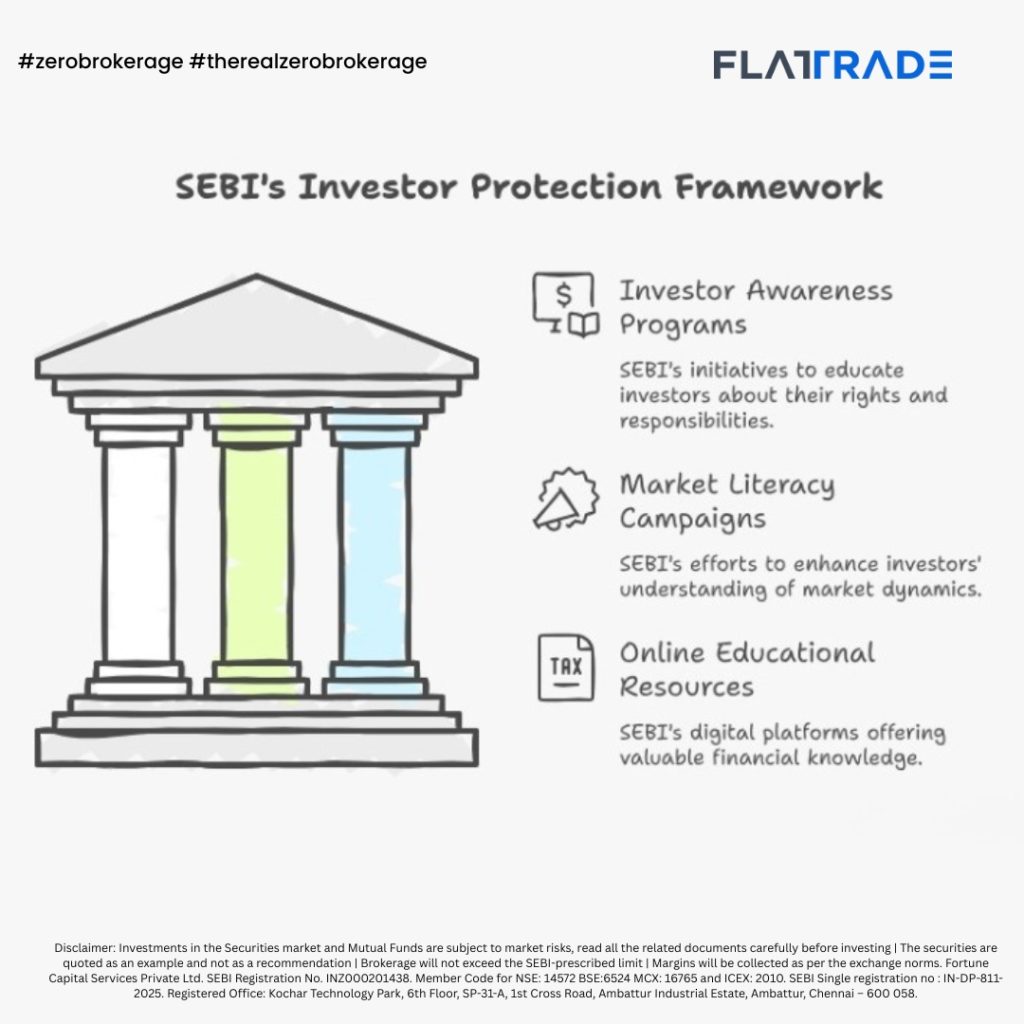
Investor Education and Awareness
Investor Grievance Redressal Mechanism
SEBI has created a structured grievance redressal system.
Process flow:
- First complaint to the broker/intermediary
- Escalation through SCORESplatform
- Exchange-level grievance handling
- Arbitration and appellate arbitration, if required
This layered system provides time-bound and accessible resolution channels.
The Bigger Picture
SEBI’s regulatory framework is designed to ensure markets do not favour only the powerful or well-connected. Instead, it aims to create a safer and more level playing field for retail participants.
In this regulated environment, platforms like Flattrade align with investor-first principles by offering a real zero brokerage model and transparent pricing. When regulatory safeguards and cost transparency work together, traders can focus more on decisions and less on hidden charges.