


Algorithmic trading is rapidly transforming how financial markets operate – and it is no longer reserved only for institutional investors. Whether you are a seasoned trader looking to automate your strategies or a beginner curious about how algorithms move markets, this comprehensive guide covers everything you need to know about algorithmic trading, how it works, its benefits, strategies, risks, and the regulatory landscape in India.
What Is Algorithmic Trading?
Algorithmic trading – also called algo trading or automated trading – means using a computer program to buy or sell securities such as stocks, futures, or options based on predefined rules and conditions. These rules can be based on price, volume, time, or complex mathematical models. When the conditions are met, the algorithm executes the trade automatically, without any human intervention.
This automated process dramatically reduces execution time and removes the emotional bias that often affects human decision-making.
Think of it this way: instead of watching charts all day and clicking “Buy” manually, you write a set of rules and let the computer do it – faster, more consistently, and without getting nervous. |
A simple example: “If the 5-minute moving average crosses above the 20-minute moving average, buy 100 shares of Company X.” When this rule is coded into the system, the algorithm scans the market continuously and executes the trade within milliseconds when the condition is triggered.
Key Components Required to Start Algorithmic Trading
Starting in algorithmic trading requires a combination of market knowledge, technical skills, and infrastructure. Here are the 12 essential components:
- Understanding of Financial Markets – A solid grasp of how markets work is the foundation. Traders must design strategies based on their own risk appetite and trading psychology.
- Programming Knowledge – Python, Java, C++, or JavaScript proficiency lets you convert trading ideas into automated code. Third-party no-code tools exist but often lack flexibility.
- Data Analysis Skills – Historical data analysis helps identify trends, patterns, and anomalies that drive profitable strategies.
- Mathematics & Statistics – Probability, regression, and statistical inference form the foundation of smarter, data-driven trading systems.
- A Defined Trading Strategy – Clearly outline entry and exit rules, risk management guidelines, and success metrics. Partial exits and re-entries must also be defined upfront.
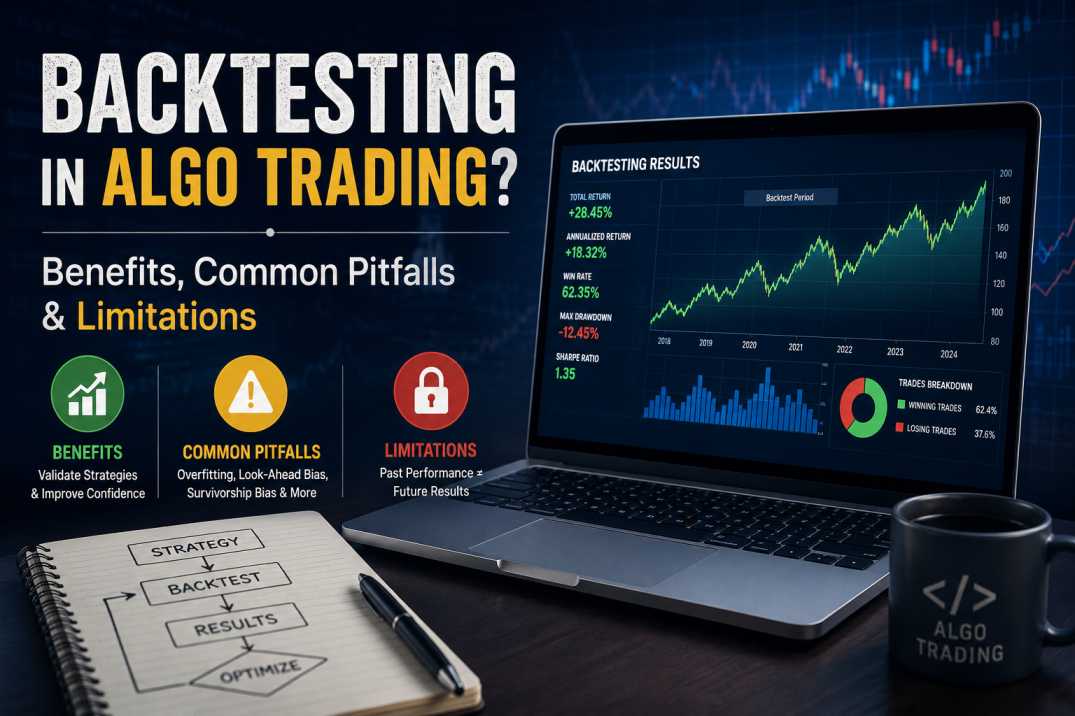
- Backtesting – Always test your strategy on historical data before going live. Python or third-party tools can be used, though paid historical data may be required.
- Reliable Data Feeds – Your algorithm is only as good as the data it receives. Real-time, accurate market data feeds are critical.
- Technology Infrastructure – Includes a stable broker API for trade execution and a robust platform or server to run your code.
- Risk Management – Every algorithm must have built-in risk controls: position sizing, stop-losses, and maximum drawdown limits.
- Continuous Monitoring – Regular performance checks and adjustments are necessary as market conditions evolve.
- Regulatory Compliance – Always follow the latest SEBI guidelines for algorithmic trading in India.
- Ongoing Optimisation – No strategy works forever. Continuously test, refine, and retire strategies that no longer perform.
Difference Between Algorithmic Trading and Manual Trading
Here is a side-by-side comparison of algorithmic trading versus manual trading:
Factor | Algorithmic Trading | Manual Trading |
Speed | Executes in milliseconds | Seconds to minutes |
Emotions | Zero emotional bias | Susceptible to fear and greed |
Consistency | Follows the same rules every time | Varies with mood and market sentiment |
Scalability | Handles multiple strategies simultaneously | Limited to one or two instruments |
Accessibility | Requires coding or platform knowledge | Easily accessible via mobile/web apps |
Error Rate | Minimal (if coded correctly) | Higher due to human error |
While algorithmic trading has a clear advantage in speed, precision, and scalability, manual trading remains more accessible for beginners. For those who master algorithmic trading, the results can be significantly more powerful.
How Does Algorithmic Trading Work?
Algorithmic trading automates the entire process of buying and selling securities using a coded set of rules. Here is a step-by-step breakdown:
Step 1 – Define Your Trading Parameters
Specify the asset class you want to trade (equities, futures, options), the strategy rules, trading objectives, and your risk tolerance.
Step 2 – Build the Algorithm
Design an algorithm that receives real-time market data, processes it against your defined logic, and triggers orders when conditions are met.
Step 3 – Backtest the Strategy
Run the algorithm on historical data to evaluate its performance under various market conditions. Identify weaknesses and refine accordingly.
Step 4 – Connect to Live Data and Broker API
Integrate the algorithm with a real-time market data feed and your broker’s API to enable live trade execution.
Step 5 – Go Live and Monitor
Deploy the algorithm in live markets. Monitor regularly and make adjustments when market dynamics shift.
Difference Between High-Frequency Trading and Algorithmic Trading
High-Frequency Trading (HFT) is often confused with standard algorithmic trading. While both rely on automation, they differ significantly:
- Speed: HFT executes thousands of trades in microseconds. Traditional algo trading typically operates on minute-level or subsecond timeframes.
- Infrastructure: HFT requires co-location servers with direct exchange access to minimise latency. Traditional algo trading runs on broker APIs and cloud platforms.
- Capital Requirements: HFT demands massive infrastructure investment and is mostly available to institutions. Traditional algo trading is accessible to retail traders.
- Strategies: HFT focuses on arbitrage, mispricing, and market making. Traditional algo trading covers trend-following, mean reversion, momentum, and indicator-based strategies.
- Accessibility: Traditional algorithmic trading is increasingly popular with retail investors through widespread broker API availability.
Key Takeaway: HFT is primarily for institutions. Traditional algorithmic trading is becoming the go-to choice for retail traders who want automation without institutional-level investment. |
Benefits of Algorithmic Trading
The growing adoption of algorithmic trading is driven by its clear advantages over manual approaches:
1. Lightning-Fast Execution
Algorithms process data, analyse patterns, and execute trades in a fraction of a second – capturing opportunities that are impossible to exploit manually.
2. Elimination of Emotional Bias
The system follows strictly predefined rules, eliminating fear, greed, and hesitation. The algorithm does exactly what it is programmed to do – every single time.
3. Multi-Strategy Scalability
An algorithmic system can run multiple strategies across different instruments simultaneously, opening far more opportunities than any individual trader can manage manually.
4. Backtesting and Validation
Before deploying real capital, traders can test their strategies on years of historical data to understand performance and refine accordingly.
5. Cost and Time Efficiency
Automation reduces manual monitoring costs and time. Faster execution also reduces slippage – a hidden cost that accumulates significantly in manual trading.
Algorithmic Trading in India: SEBI Regulations
SEBI is actively working to regulate algorithmic trading for retail investors in the interest of market transparency and integrity. Key regulations include:
- All algorithmic strategies used by retail investors through brokers must be approved by exchanges and tagged with unique Algorithm IDs.
- Brokers must ensure proper risk controls, audit trails, and customer consent before distributing algorithmic strategies.
- SEBI discourages unregulated third-party algorithm providers and holds brokers directly accountable for the algorithms offered on their platforms.
- These rules protect retail traders from opaque black-box strategies and build trust in the growing retail algo trading ecosystem.
Stay Updated: SEBI’s rules for algorithmic trading are evolving. Always refer to the latest SEBI circulars and your broker’s compliance guidelines before deploying any strategy. |
To read more on the exchange circular click here
Conclusion
Algorithmic trading represents the future of retail investing in India and globally. It offers unmatched speed, precision, consistency, and scalability that no human trader can replicate manually. However, it is not a shortcut to guaranteed profits. Success in algo trading requires a strong foundation in market knowledge, programming, data analysis, and disciplined risk management.
Whether you are a beginner taking your first steps into automation or an experienced trader looking to scale your strategies, the key is to start simple, backtest rigorously, and never stop learning. The markets are always evolving – and so must your algorithms.