


The Indian stock market has changed dramatically over the last decade.
More investors. More access. More participation.
Which brings up a natural question:
Who is really moving the markets today?
Is it the growing army of retail investors?
Or the deep pockets of institutional money?
Let’s break it down.
Two Forces in the Market
Retail Investors
Retail investors are individual participants investing their own money across equities, mutual funds, IPOs, derivatives, and SIPs.
They include:
- Salaried professionals
- Business owners
- First-time investors entering through digital platforms
Individually, their capital may be small.
But collectively, their impact is hard to ignore.
Institutional Investors
Institutional investors deploy large pools of capital on behalf of clients or stakeholders.
They broadly include:
- Foreign Institutional Investors (FIIs)
- Domestic Institutional Investors (DIIs)
Because of their scale, their decisions can significantly influence market direction.
The Big Shift: Rise of Retail Participation
Retail participation in India has surged over the last few years.
Key indicators:
- Demat accounts crossing 45 million (early 2026)
- Strong growth in SIP investments
- Increased participation from younger investors
Retail investors are especially active in:
- Mid-cap and small-cap stocks
- IPO subscriptions
- Short-term trading and derivatives
What this means is simple:
Retail investors are now driving liquidity and momentum in the market.
The Anchor: Institutional Strength
Despite the rise of retail investors, institutions continue to play a critical role.
A major shift happened recently:
Domestic Institutional Investors (DIIs) have overtaken FIIs in equity ownership for the first time in over two decades.
By 2025–2026:
- DIIs held ~18.7% of NSE-listed equities
- Supported by strong inflows (~₹6 trillion in 2025)
DIIs bring:
- Long-term investing approach
- Research-driven decisions
- Stability during volatile periods
When FIIs sell, DIIs often absorb the pressure.
That’s a big reason why markets today are more resilient.
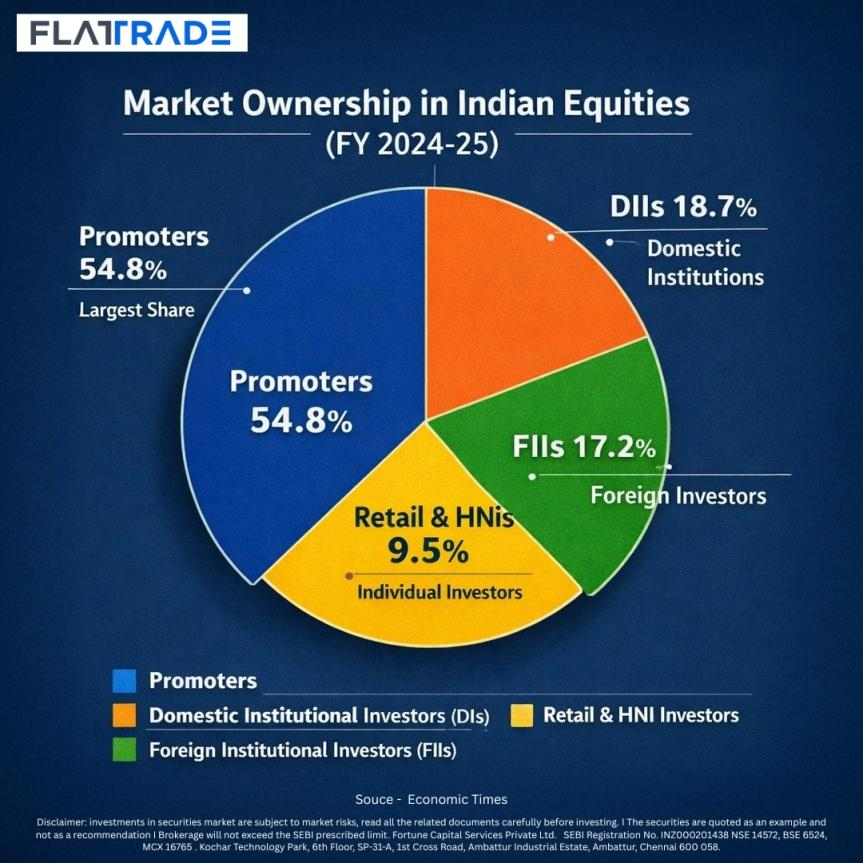
Who Is Really Driving the Market?
The answer is no longer one-sided.
Today’s market is shaped by both forces working together:
- Retail investors → drive participation, liquidity, and short-term momentum
- Institutional investors → influence direction, stability, and long-term trends
This combination has made Indian markets deeper and more balanced than before.
What This Really Means for Investors?
Markets today are:
- Less dependent on foreign capital alone
- More supported by domestic participation
- Structurally stronger than before
That’s a meaningful shift.
Final Thoughts
In 2026, the Indian stock market is not driven by a single player.
It’s a mix of:
- Retail investors bringing scale and participation
- Domestic institutions providing stability
- Foreign investors influencing global sentiment
This balance is what makes the market more resilient.
And as participation continues to grow, access to markets is becoming simpler through platforms like Flattrade, enabling more investors to be part of this evolving ecosystem.