



Intraday trading means buying and selling stocks within the same trading day – before the market closes at 3:30 PM. You don’t hold any position overnight. The goal is simple: profit from small price movements that happen during the day.
Sounds exciting? It is. But it also requires discipline, a clear strategy, and good risk management. Without a strategy, intraday trading is just gambling.
In this blog, we’ll walk you through the most commonly used intraday trading strategies in Indian markets.
If you’re new to intraday trading, start with Opening Range Breakout or Momentum Trading. They’re simpler to understand and easy to practice on paper first.
Before We Begin: The Basics of Indian Intraday Trading
Indian markets (NSE and BSE) are open from 9:15 AM to 3:30 PM, Monday to Friday. Most intraday action happens in:- The first hour (9:15 AM – 10:15 AM) – highest volatility
- Midday (11:30 AM – 1:30 PM) – usually quieter
- Last hour (2:30 PM – 3:30 PM) – picks up again as positions get squared off
1. Momentum Trading
What is it?
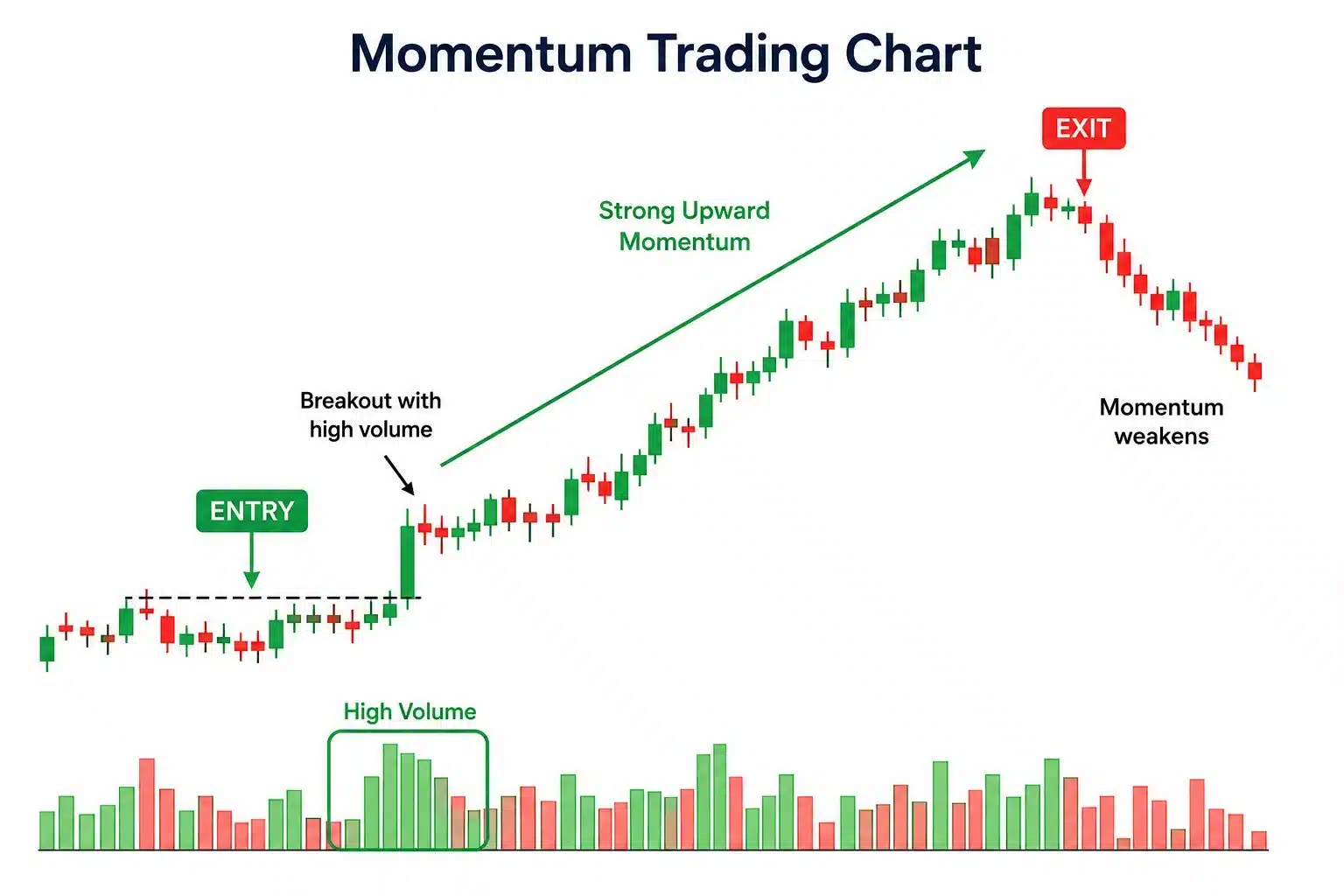
Momentum trading is riding the wave. When a stock is moving strongly in one direction, you jump in and ride that move – then exit before it reverses. Think of it like surfing. You wait for the right wave, get on it, and get off before it crashes.How it works in practice:
- 1Look for stocks that are making strong moves early in the morning (9:15 AM – 10:00 AM)
- 2These are often stocks in the news – results, upgrades, big deals, sector buzz
- 3Buy when the stock breaks above a recent high, or sell short when it breaks below a low
- 4Exit when momentum slows down (volume drops, price stalls)
📊 Example:
Imagine Tata Motors announces strong quarterly results before market open. The stock gaps up and starts rallying. A momentum trader buys early, rides the move for ₹15–₹20, and exits.
Tools to use:
- Volume (high volume = strong momentum)
- RSI (Relative Strength Index) above 60 for bullish momentum
- 5-minute or 15-minute candlestick charts
⚠️ Risk: Momentum can reverse quickly. Always use a stop-loss – typically 0.5% to 1% below your entry.
2. Breakout Trading
What is it?
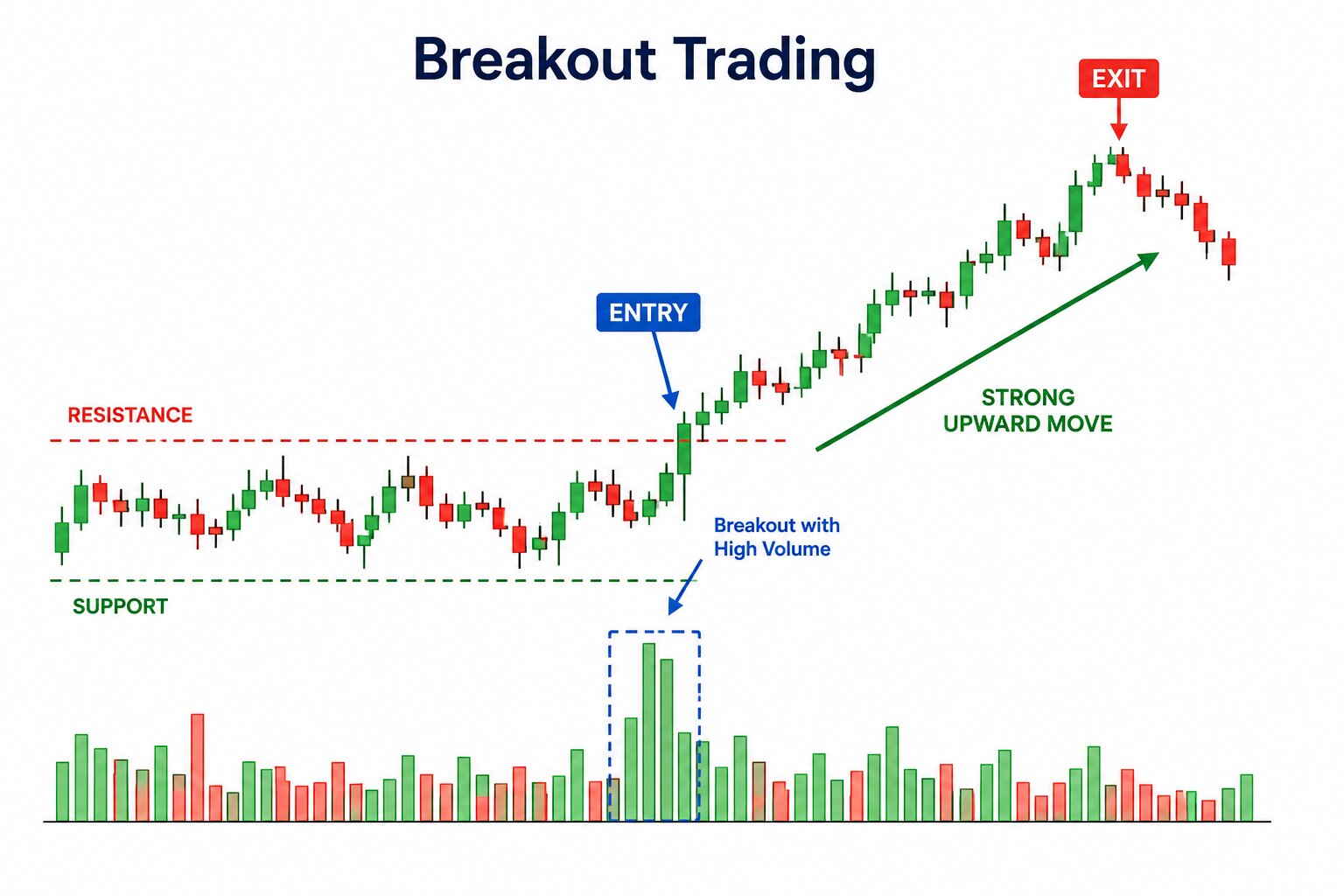
Every stock moves within a range – a high point and a low point. When it breaks out of that range, it often makes a big move. Breakout traders try to catch that move.How it works in practice:
- 1Identify a stock that has been stuck in a tight range (e.g., between ₹500 and ₹510 for the past few hours)
- 2When the price breaks above ₹510 with high volume, that’s a breakout – buy
- 3When the price breaks below ₹500 with high volume, that’s a breakdown – short sell
- 4Set your target at the next resistance level, and stop-loss just below the breakout point
📊 Example:
Reliance Industries has been trading between ₹2,800 and ₹2,820 all morning. At 11:30 AM, it breaks above ₹2,820 with 3x the usual volume. A breakout trader buys here, targeting ₹2,850–₹2,860.
Tools to use:
- Horizontal support and resistance levels
- Volume confirmation (must be above average)
- 15-minute charts work well for this strategy
⚠️ Risk: False breakouts are common. A stock can break out briefly and then fall back into the range – called a “fakeout.” Volume confirmation helps filter these out.
3. Reversal Trading (Mean Reversion)
What is it?
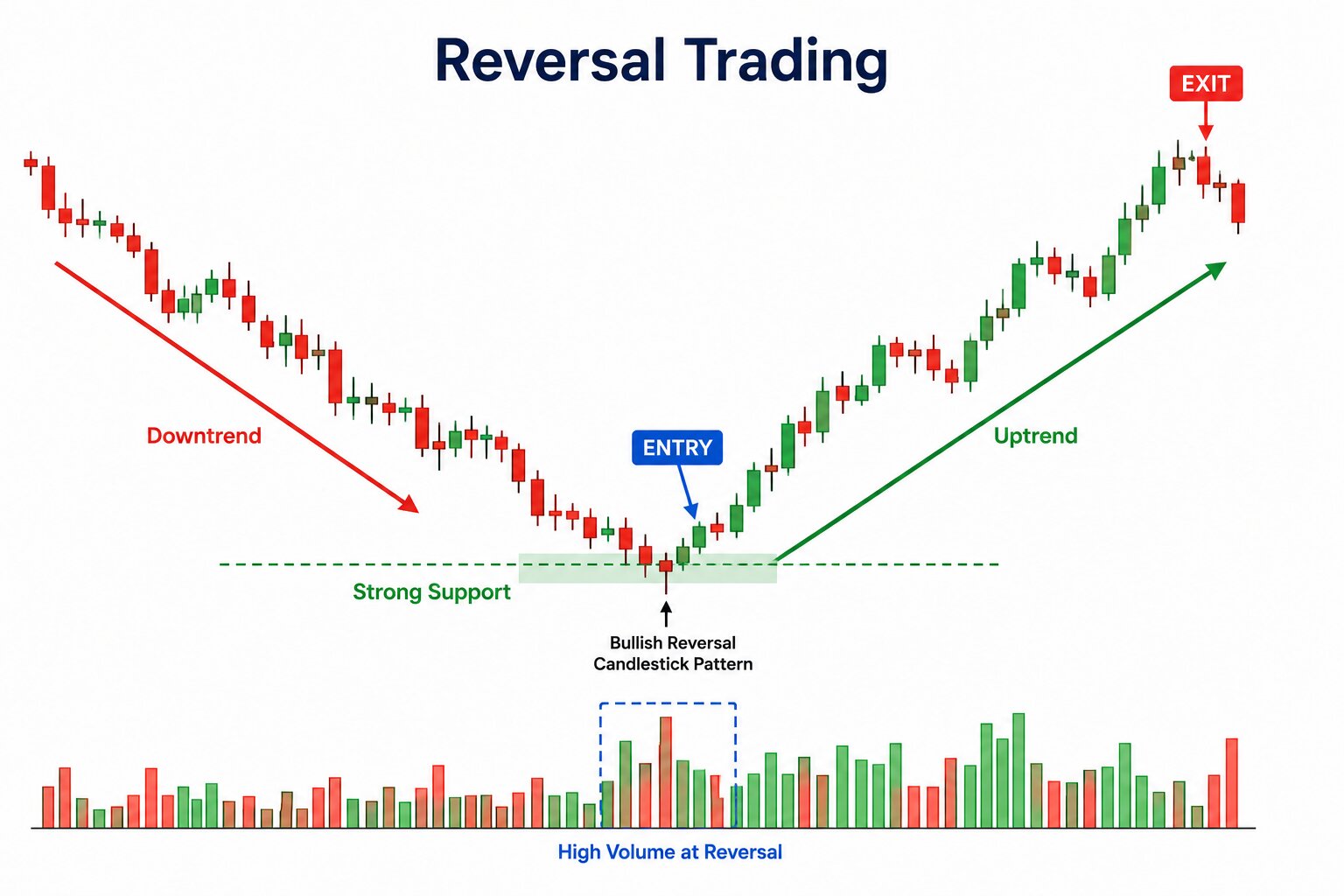
What goes up too fast, often comes back down – and vice versa. Reversal trading is about identifying when a stock has moved too far in one direction and betting on it coming back. This strategy goes against the current trend, so it requires more skill and experience.How it works in practice:
- 1Look for stocks that have made a very sharp move – up or down – and are showing signs of exhaustion
- 2Signs include: long wicks on candles, RSI above 80 (overbought) or below 20 (oversold), falling volume after a big move
- 3Enter in the opposite direction with a tight stop-loss
📊 Example:
A mid-cap pharma stock shoots up 4% in the first 15 minutes on no major news. RSI hits 85. A reversal trader shorts the stock expecting a pullback, targeting a return to the opening price.
Tools to use:
- RSI (above 75–80 = overbought; below 20–25 = oversold)
- Candlestick patterns (shooting star, doji, engulfing candles)
- VWAP (Volume Weighted Average Price) – price coming back to VWAP is a common reversal target
⚠️ Risk: Reversals can fail if the momentum is very strong. This is a counter-trend strategy, so always keep your stop-loss tight.
4. VWAP Trading
What is it?
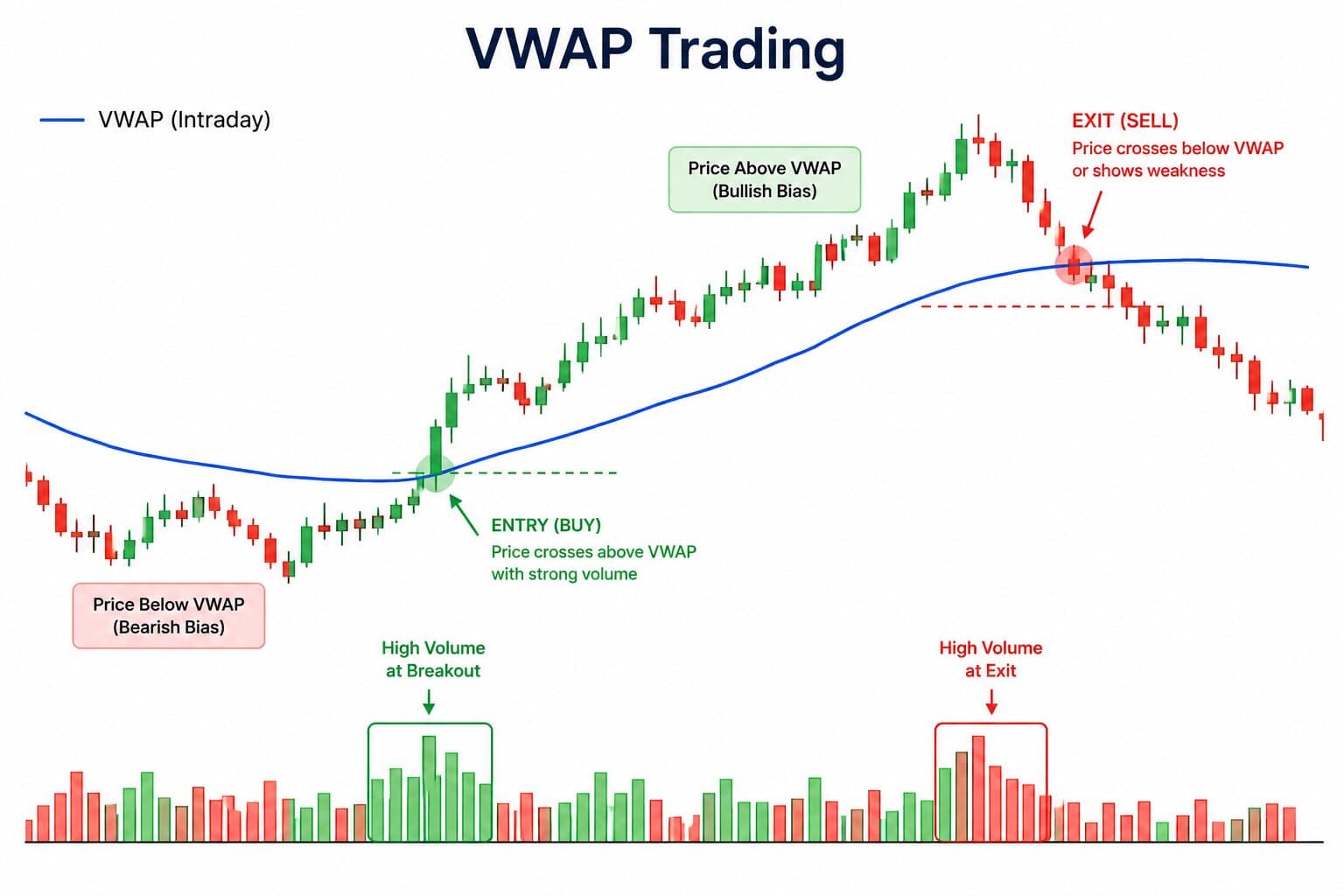
VWAP stands for Volume Weighted Average Price. It’s the average price at which a stock has traded throughout the day, weighted by volume. It’s one of the most widely used tools by professional traders. Think of VWAP as the “fair value” of a stock for the day.How it works in practice:
- 1Price above VWAP = stock is bullish for the day → look for buying opportunities
- 2Price below VWAP = stock is bearish for the day → look for selling (short) opportunities
- 3When price pulls back to VWAP and bounces, that’s a good entry point
📊 Example:
Infosys opens at ₹1,500 and VWAP is at ₹1,490 by 11 AM. The stock dips to ₹1,491, touches VWAP, and bounces back up. A VWAP trader buys at ₹1,491 with a stop-loss at ₹1,485.
Tools to use:
- VWAP indicator (available on all major charting platforms including Flattrade’s platform)
- 5-minute charts
- Combine with support/resistance for better entries
⚠️ Risk: VWAP works best in trending markets. In choppy, sideways markets, price keeps crossing VWAP and signals become unreliable.
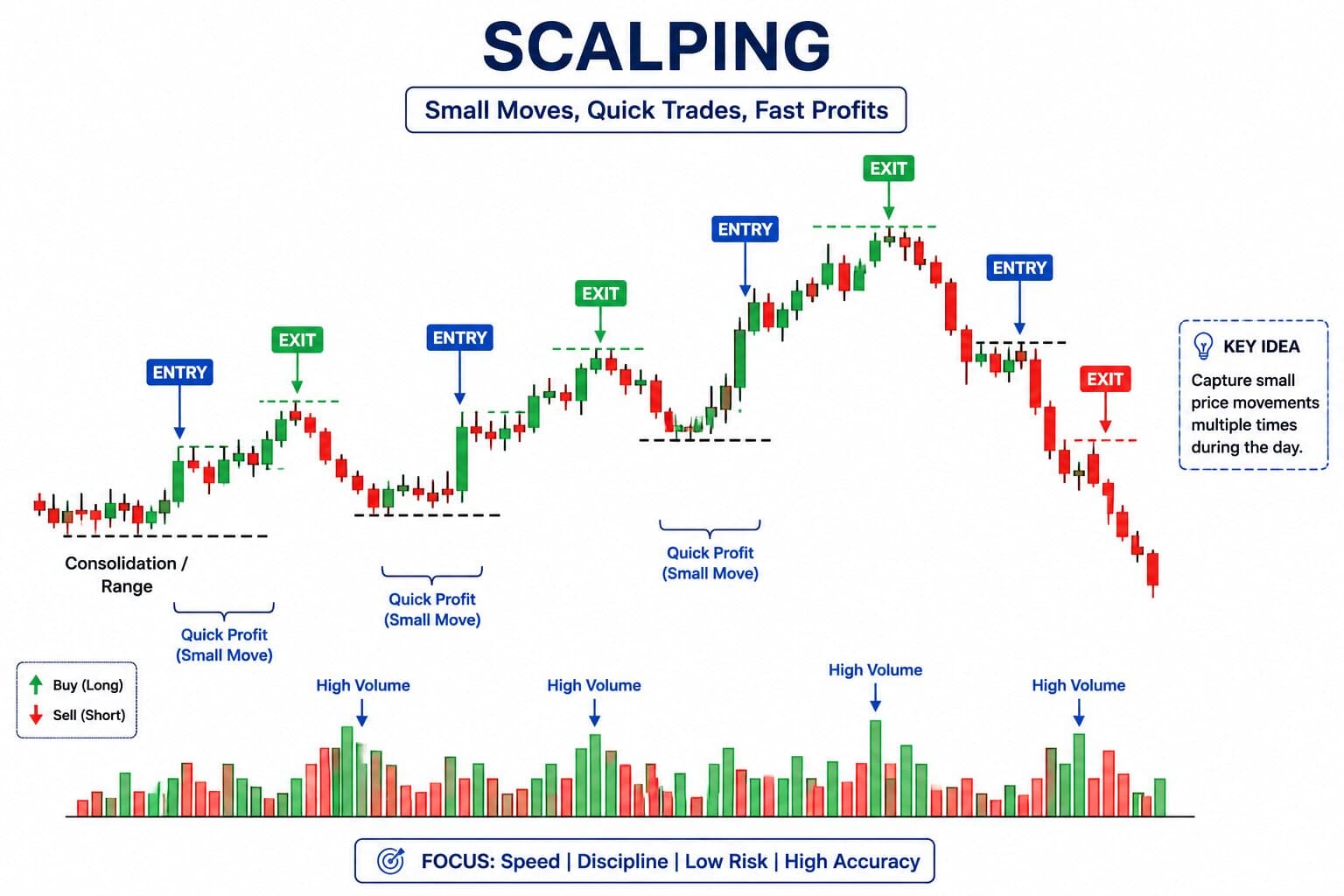
5. Scalping
What is it?
Scalping is the fastest style of intraday trading. Scalpers make many small trades throughout the day, each targeting just ₹1 to ₹5 of profit per share – but they do this dozens of times. It’s like collecting small coins all day instead of hunting for one big note.How it works in practice:
- 1Focus on highly liquid stocks like NIFTY 50 stocks or Bank Nifty options
- 2Enter and exit within minutes or even seconds
- 3Use very tight stop-losses (often ₹1–₹2)
- 4Aim for a high win rate on many trades
📊 Example:
A scalper trades SBI 20–30 times a day, making ₹2–₹3 per trade. Even if 60% of trades win, that adds up.
Tools to use:
- 1-minute charts
- Level 2 data / order book (bid-ask spread)
- High-speed execution platform (important!)
- Tape reading skills
⚠️ Risk: Scalping has high brokerage costs if your broker charges per trade. With Flattrade’s zero brokerage model, scalping becomes more viable! It also requires intense focus and fast decision-making. Not ideal for beginners.
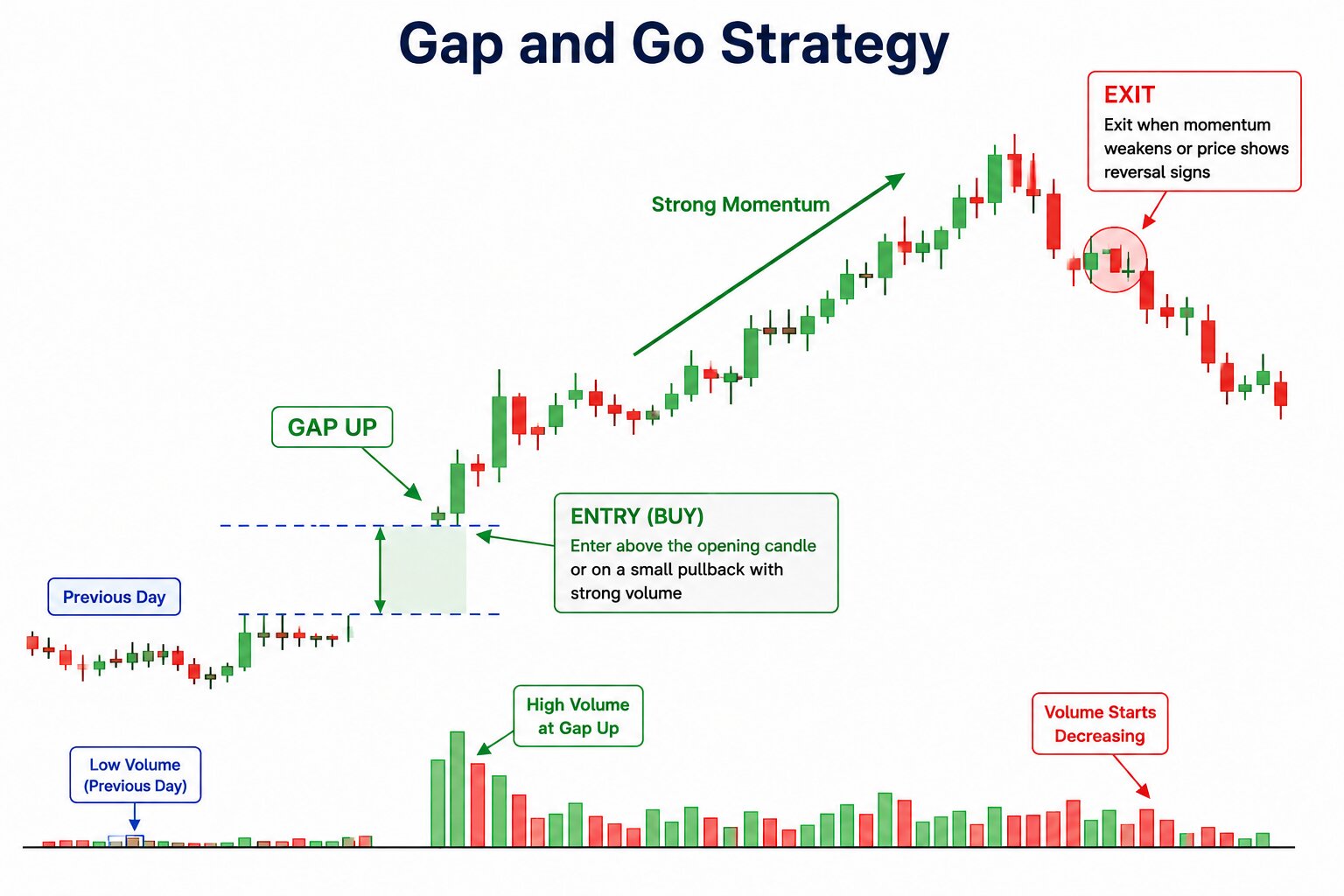
6. Gap and Go Strategy
What is it?
Sometimes a stock opens significantly higher or lower than yesterday’s closing price – this is called a “gap.” The Gap and Go strategy bets that the stock will continue moving in the direction of the gap.How it works in practice:
- 1Before market opens, scan for stocks that are likely to gap up or gap down (based on pre-market news)
- 2When the market opens, wait for the first 5–15 minutes to see if the gap holds
- 3If the stock gaps up and keeps going → buy
- 4If the stock gaps down and keeps going → short sell
📊 Example:
HDFC Bank closes at ₹1,700. Next morning, strong results are announced. It opens at ₹1,740 – a gap up of ₹40. In the first 15 minutes, it moves to ₹1,745. A Gap and Go trader buys here, targeting ₹1,760–₹1,770.
Tools to use:
- Pre-market scanner (check NSE announcements, earnings calendars)
- 5-minute charts for the first candle
- Volume – gap must have strong volume to be reliable
⚠️ Risk: Gaps sometimes fill (reverse back to previous day’s close). If the stock gaps up but then starts falling, exit quickly. The first 15 minutes can be very tricky.
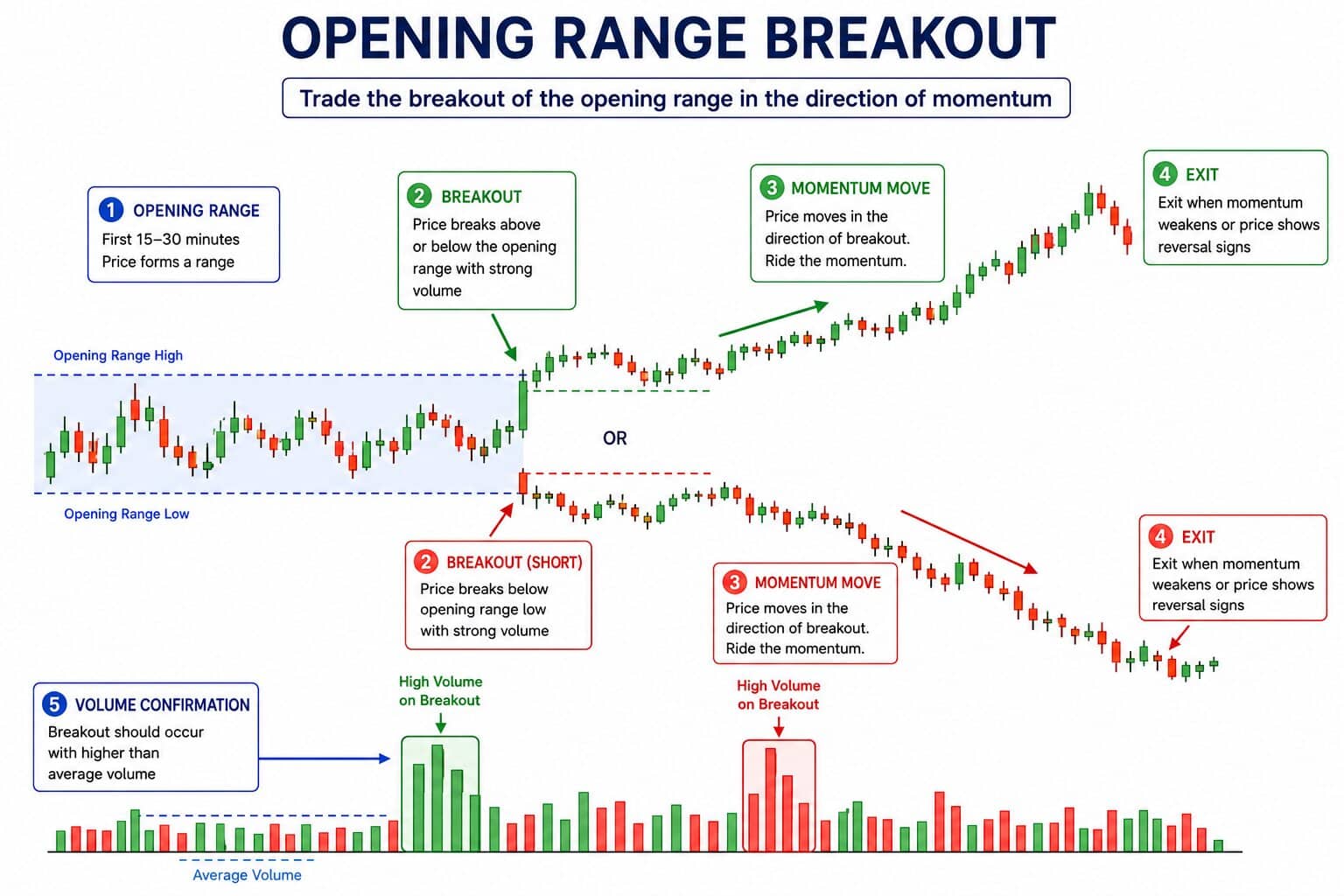
7. Opening Range Breakout (ORB)
What is it?
This is one of the most popular intraday strategies in India. The idea is simple: the high and low of the first 15 or 30 minutes of trading creates a “range.” When price breaks out of this range, you trade in that direction.How it works in practice:
- 1Note the high and low of the first 15 minutes (9:15 AM to 9:30 AM)
- 2If price breaks above the high → buy
- 3If price breaks below the low → short sell
- 4Stop-loss = opposite end of the opening range
- 5Target = 1.5x to 2x the range size
📊 Example:
Between 9:15 and 9:30, Nifty 50 trades between 22,400 and 22,450. At 9:45, it breaks above 22,450. A trader buys Nifty futures at 22,455, with a stop at 22,400 and target at 22,510–22,520.
Tools to use:
- 15-minute charts
- Mark the opening range high and low clearly
- Works very well on Bank Nifty and Nifty 50 index as well as large-cap stocks
⚠️ Risk: The opening range can be wide on volatile days, making the risk too large. On such days, it’s better to skip the trade.
Key Rules Every Intraday Trader Should Follow
No matter which strategy you use, these rules are non-negotiable:- 1Always Use a Stop-Loss This is the #1 rule. Decide your maximum loss before entering a trade. Stick to it.
- 2Don’t Risk More Than 1–2% Per Trade If your trading capital is ₹1,00,000, don’t risk more than ₹1,000–₹2,000 on any single trade.
- 3Square Off Before 3:20 PM Don’t wait until the last minute. Exit intraday positions by 3:20 PM to avoid auto square-off charges from your broker.
- 4Trade with the Trend As a beginner, avoid betting against strong market trends. Following the trend is usually the safer choice.
- 5Keep a Trading Journal Write down every trade – entry, exit, reason, outcome. Review it weekly. This is how you improve.
- 6Don’t Overtrade More trades ≠ more profit. Sometimes the best trade is no trade. Wait for your setup.
Which Strategy is Right for You?
| Strategy | Best For | Difficulty Level |
|---|---|---|
| Momentum Trading | Beginners–Intermediate | |
| Breakout Trading | Beginners–Intermediate | |
| Reversal Trading | Intermediate–Advanced | |
| VWAP Trading | Intermediate | |
| Scalping | Advanced | |
| Gap and Go | Intermediate | |
| Opening Range Breakout | Beginners–Intermediate |