

Amit had been trading for almost a year.
He wasn’t a beginner anymore.
He could read charts, identify support and resistance, and understood the importance of stop losses. But despite all his learning, there was one thing he still struggled with.
He hated losing.
On a Monday morning, Amit spotted a stock that looked ready for a breakout. The setup looked perfect. Volumes were rising, momentum was strong, and the broader market sentiment was positive.
He entered the trade confidently.
An hour later, his stop loss was hit.
“Fine,” he thought. “Bad luck.”
Later that afternoon, another opportunity appeared. This setup looked even better. Confident that the first loss was just temporary, he entered again.
Another loss.
Annoyed but still composed, he took a third trade.
Loss again.
Three losing trades in one day.
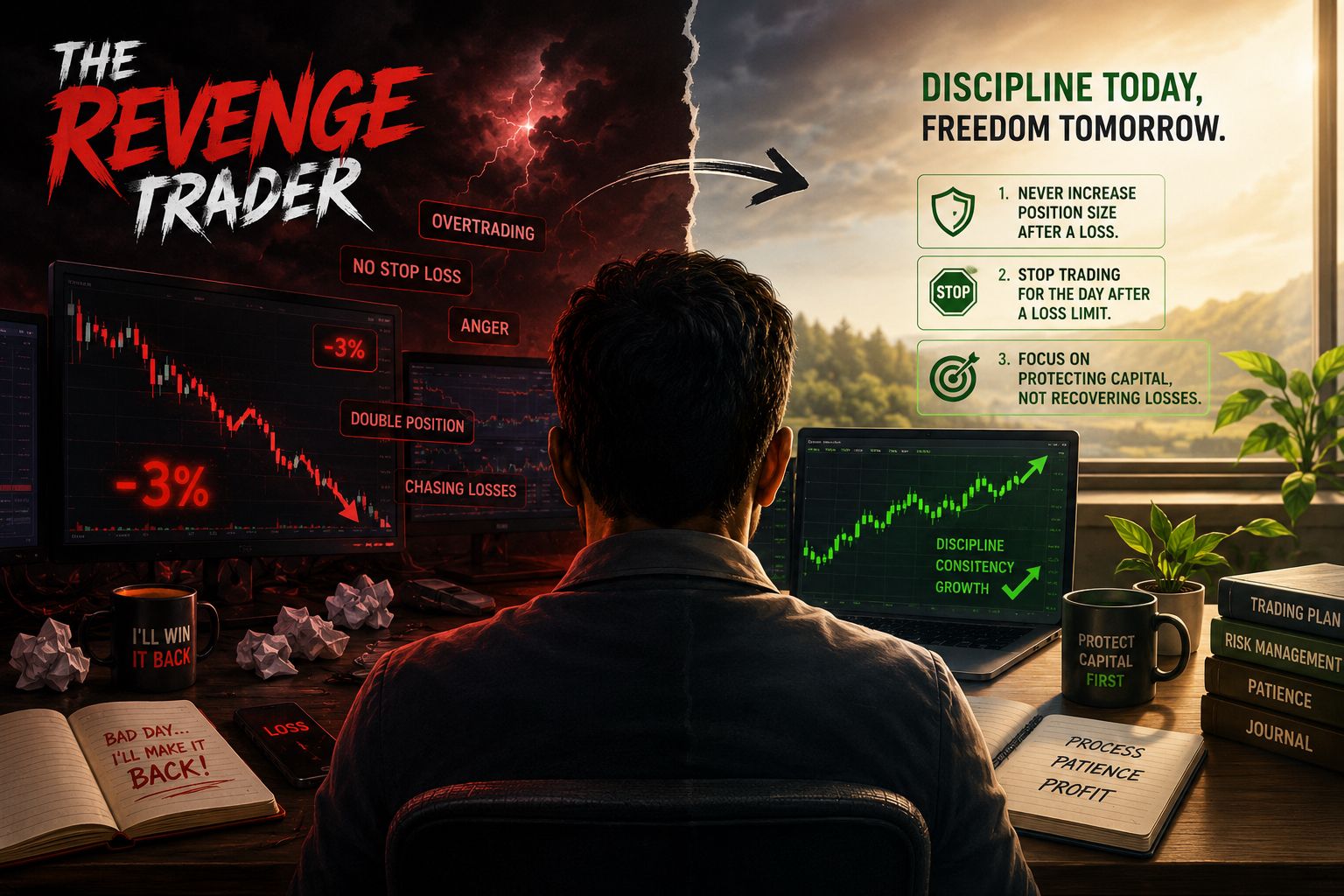
His account was down just 3%.
The losses themselves weren’t serious. But something far more dangerous had taken over.
His emotions.
Amit stared at his screen.
“I know I’m not wrong,” he muttered.
“The market can’t keep going against me.”
Instead of taking a break, he started searching desperately for another opportunity. Not because it was a good setup.
Because he wanted revenge.
A fast-moving stock caught his attention.
Without his usual analysis, he jumped in.
And this time, he doubled his position size.
“If this works, I’ll recover everything and end the day in profit.”
For a few minutes, the stock moved higher.
His confidence returned.
“There you go. I knew I was right.”
Then sellers entered the market.
The stock reversed sharply.
His stop loss approached.
He moved it lower.
The price fell again.
He removed the stop loss completely.
He couldn’t bear the thought of another loss.
Within minutes, the stock dropped even further.
By the closing bell, Amit had lost more money on that single trade than he had lost during the entire previous month.
That evening, he sat quietly with his trading journal.
He reviewed the charts.
And the truth hurt.
His first three trades had actually been good setups.
The losses were normal.
Nothing unusual had happened.
The real damage came from the fourth trade.
The trade he had taken out of anger.
The trade he had taken to “win it all back.”
That’s when he realised something important.
The market doesn’t know you had a bad day.
It doesn’t owe you a recovery.
And it never rewards emotional decisions.
From that day, Amit made three promises to himself.
- Never increase position size after a loss.
- Stop trading for the day after reaching a predefined loss limit.
- Focus on protecting capital, not recovering losses.
Months later, Amit became consistently profitable.
Not because he discovered a secret indicator.
Not because he predicted the market better.
But because he learned to control the person sitting in front of the screen.
Because in trading, survival comes first.
A trader who protects capital can always come back tomorrow.
But a trader who tries to take revenge on the market often discovers that the market doesn’t fight back.
It simply takes what’s offered.