

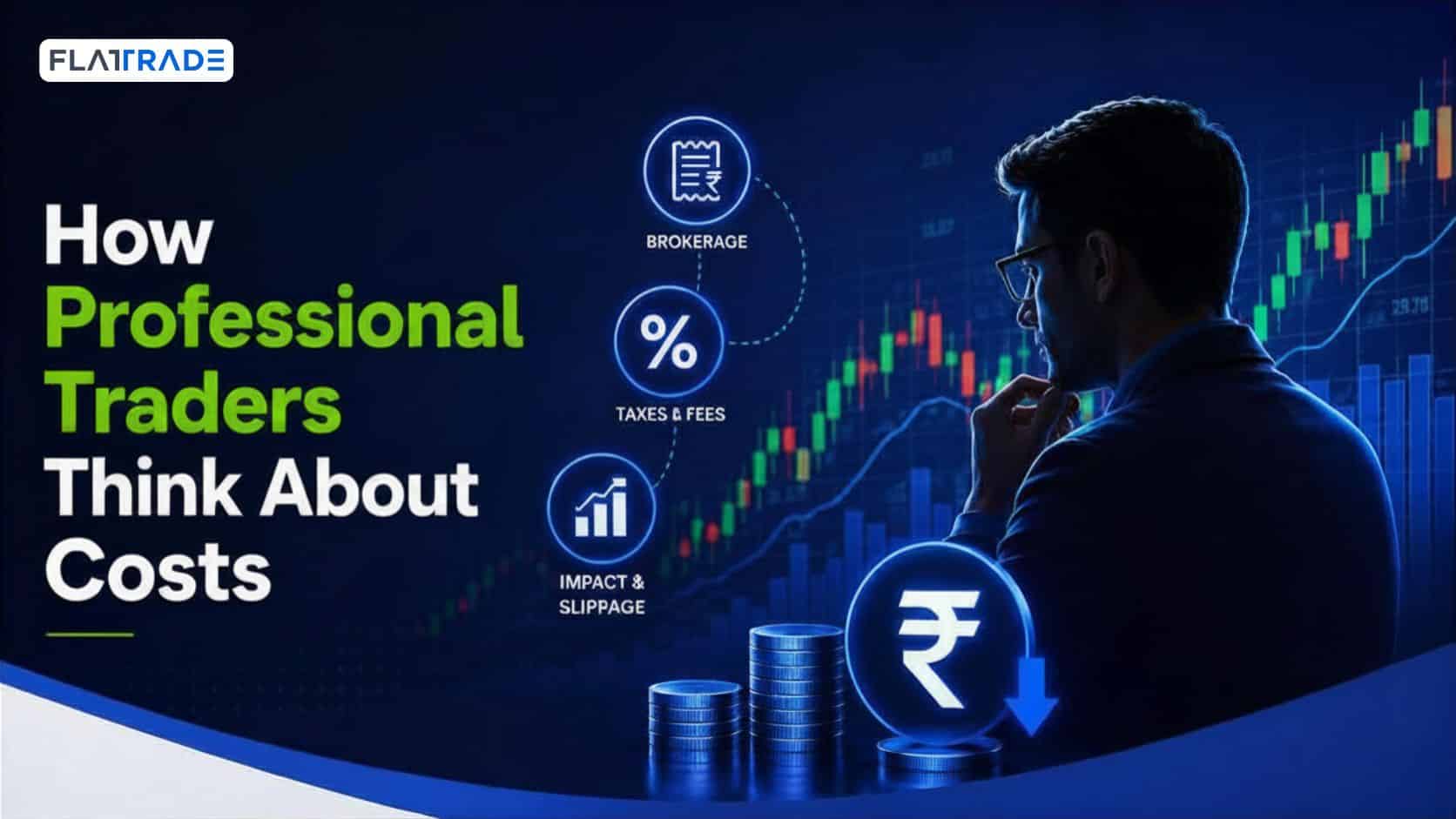
Ask a new trader what trading costs them, and most will say one thing: brokerage. Ask a professional trader the same question, and you’ll usually get a longer answer – because brokerage is just one piece of a bigger picture.
Professional and experienced traders tend to think about cost differently. They look beyond the fee charged per order and consider a wider set of charges and hidden costs that quietly affect what they actually keep at the end of a trade. Understanding this way of thinking can help any trader – beginner or experienced – make more informed decisions.
What Do We Mean by “Trading Costs”?
Trading costs are the total cost of buying and selling a security, not just the brokerage fee. They are usually split into two broad categories:
- Explicit costs: Charges you can see clearly on your trade statement, such as brokerage, taxes, and regulatory fees.
- Implicit costs: Costs that don’t appear as a line item but still affect your outcome, such as slippage, impact cost, and the cost of poor timing.
Here’s a general breakdown of the components that can make up trading costs. Actual rates, applicability, and rules can change and vary by segment (equity, F&O, currency, commodity), so always verify current charges on the relevant exchange (NSE, BSE, MCX), SEBI, or your broker’s official pricing page rather than assuming a fixed number.
| Cost Component | What It Is | Who Sets or Causes It |
|---|---|---|
| Brokerage | Fee charged by a broker for executing your order | The broker |
| Securities/Commodity Transaction Tax (STT/CTT) | A transaction-based tax applicable on certain trades | Government of India |
| Stamp Duty | A duty applicable on transaction value | State governments |
| GST | Tax applicable on brokerage and certain other charges | Government of India |
| Exchange Transaction Charges | Fee for using the exchange’s trading infrastructure | NSE/BSE/MCX |
| SEBI Turnover Fees | A regulatory fee on turnover | SEBI |
| Depository Charges | Charges related to holding securities in Demat form | CDSL/NSDL, via your Depository Participant |
| Slippage | Difference between the price you expected and the price at which your order actually executed | Market movement between order placement and execution |
| Impact Cost | Price movement caused by placing a large order in a less liquid security | Market depth and liquidity |
Why Does This Way of Thinking Matter?
- Costs reduce net returns. Even small, recurring costs can add up meaningfully over many trades or a long holding period.
- Zero brokerage does not mean zero cost. Even where brokerage is nil, statutory taxes, exchange charges, and implicit costs like slippage can still apply.
- Frequent traders feel costs more. The more often you trade, the more these charges repeat, which is why cost awareness matters more for active or short-term traders than for long-term, buy-and-hold investors.
- It improves decision quality. Understanding the true cost of a trade helps you judge whether a strategy is genuinely worthwhile, rather than looking only at the potential upside.
How Professional Traders Approach Costs
Here are some common habits and approaches that experienced traders tend to use when thinking about costs. These are educational observations about common practices, not instructions or guarantees of any outcome.
-
They separate explicit costs from implicit costs
Rather than looking only at brokerage, they account for taxes, exchange charges, and estimated slippage or impact cost before judging whether a trade idea makes sense.
-
They think in terms of cost as a share of capital or expected outcome
Instead of viewing a charge in isolation, they consider it relative to the size of the trade and the outcome they are aiming for, since the same cost matters more on a smaller trade than a larger one.
-
They plan for impact cost on large or less liquid orders
For bigger orders, or orders in less liquid securities, they may break an order into smaller parts or use limit orders instead of market orders to reduce the effect of their own order on the price.
-
They track the cost of overtrading
Placing many trades in a short period can quietly increase total costs, even if each individual charge looks small. Experienced traders often review how often they trade, not only what they trade.
-
They use tools that support more precise execution
Order types that allow conditions to be set in advance, or platforms that support rule-based execution, can help reduce the chances of paying more due to poor timing or manual delays.
-
They review costs periodically, not just returns
Alongside checking profit and loss, many experienced traders periodically review how much they paid in total charges over a period, to understand the real drag on their performance.
Example
Consider two traders who both act on the same trade idea (this is a simplified, illustrative scenario to explain the concept – not a real trade, recommendation, or actual figures):
- Trader A only checks the brokerage before placing the trade and uses a market order without checking liquidity.
- Trader B checks brokerage, is aware that taxes and exchange charges will also apply, and uses a limit order after checking the security’s typical trading volume.
Trader A may end up paying more overall due to unaccounted charges and a larger-than-expected impact cost from the market order, especially if the security isn’t very liquid. Trader B, by thinking about the full cost picture and choosing a more considered order type, is in a better position to know the real cost of the trade before it happens. The point isn’t that one order type is always superior – it’s that understanding the full cost picture, in advance, leads to better-informed decisions.
Advantages of Thinking About Costs This Way
- More realistic expectations: You judge a trade or strategy on what you might actually keep, not just the gross outcome.
- Better strategy evaluation: Strategies that look attractive on paper may look different once realistic costs are factored in, especially for frequent trading.
- Improved discipline: Awareness of the cost of overtrading can naturally reduce impulsive or excessive trading.
- Better order-placement choices: Understanding impact cost and slippage can guide more thoughtful use of order types.
Risks or Limitations
- Costs are only part of the picture: Managing costs well does not eliminate market risk. Prices can still move against a position regardless of how efficiently it was executed.
- Charges can change: Tax rates, exchange charges, and regulatory fees are set by the relevant authorities and can be revised, so figures should always be verified from official sources at the time of trading.
- Over-focusing on cost minimisation: Chasing the lowest possible cost at the expense of trade quality or timing can sometimes be counterproductive.
- Implicit costs are estimates: Slippage and impact cost can only be estimated in advance; the actual amount depends on market conditions at the time of execution.
Common Mistakes to Avoid
- Looking only at brokerage: Ignoring taxes, exchange charges, and implicit costs gives an incomplete picture of true cost.
- Assuming “zero brokerage” means “zero cost”: Statutory charges and market-driven costs like slippage can still apply.
- Ignoring liquidity before placing large orders: This can lead to a larger-than-expected impact cost.
- Overtrading without tracking cumulative charges: Frequent small trades can add up to a meaningful cost over time.
- Not reviewing cost reports or statements: Skipping periodic review makes it harder to notice cost patterns and adjust behaviour.
Tips and Best Practices
- Read your contract notes and statements: These typically break down brokerage, taxes, and other charges for each trade.
- Check liquidity before large orders: Looking at recent trading volume can help you anticipate impact cost.
- Use appropriate order types: Depending on your goal, conditional or limit-based orders can help manage execution price more precisely than a plain market order.
- Track your own trading frequency: Periodically review how many trades you placed and the cumulative charges involved.
- Verify rates from official sources: Refer to NSE, BSE, MCX, and SEBI websites, and your broker’s official charges page, for current and accurate figures.
Frequently Asked Questions
Is brokerage the biggest cost in trading?
Not always. Depending on the broker, segment, and trading style, statutory charges, taxes, and implicit costs like slippage or impact cost can sometimes matter as much as, or more than, brokerage itself.
If brokerage is zero, are there really no other costs?
No. Even with zero brokerage, charges such as statutory taxes, exchange transaction charges, SEBI turnover fees, and depository charges may still apply, along with implicit costs like slippage.
What is the difference between slippage and impact cost?
Slippage refers to the difference between the price you expected and the price at which your order actually got executed, often due to market movement. Impact cost specifically refers to price movement caused by your own order size relative to the market’s liquidity.
Do these cost considerations matter for long-term investors too?
Yes, though usually to a smaller degree since long-term investors trade less frequently. Even so, understanding statutory charges and taxes on gains remains relevant for overall financial planning.
Where can I check the exact charges applicable to my trades?
You can check your broker’s official pricing or charges page, your contract notes and account statements, and the official websites of NSE, BSE, MCX, and SEBI for current rates and regulations.
Conclusion
Thinking about trading costs the way professionals do isn’t about chasing the cheapest possible trade – it’s about seeing the full picture before you act. Explicit charges like brokerage and taxes are easy to spot, but implicit costs like slippage and impact cost quietly shape your real outcome too.
You don’t need to track every charge manually to benefit from this mindset. Reading your statements, checking liquidity before large orders, being mindful of how often you trade, and verifying current charges from official sources are simple habits that bring you closer to how experienced traders evaluate their own trades.
Flattrade Feature
Since execution quality is a big part of managing trading costs, the tools you trade with matter. Flattrade offers Zero Brokerage on Equity, F&O, Currency, and Commodity trades, which removes one component of explicit cost – though statutory charges, taxes, and market-driven costs like slippage can still apply.
For more precise execution, Flattrade also offers order types such as GTT (Good Till Triggered), OCO (One Cancels Other), Bracket Orders, and Cover Orders, along with Trade from Charts for placing orders directly off a chart. Traders who want a more systematic, rule-based approach can explore the Strategy Builder or Trading APIs for algo trading.
As always, no order type or platform feature removes market risk – they are tools to help you execute your own trading decisions more precisely, not a way to guarantee outcomes.