

Corporate actions can change how your holdings appear overnight. One such action is share consolidation. While the number of shares and the market price may change, the underlying value of your investment does not. Here’s a clear explanation of what share consolidation means, why companies opt for it, and how it impacts investors.
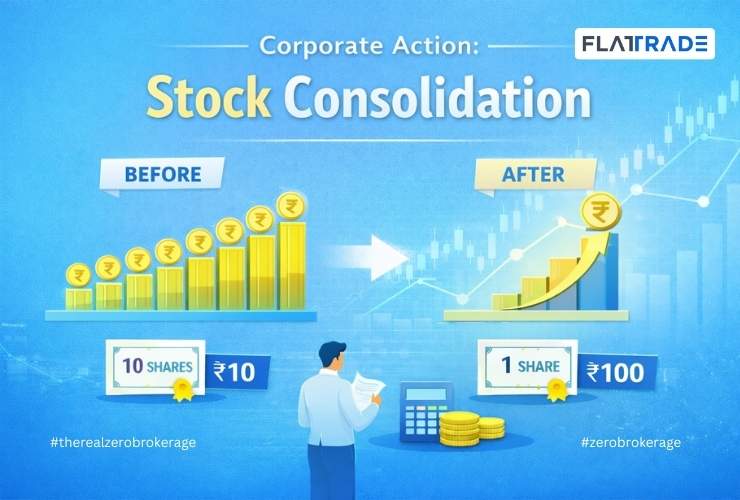
Share consolidation is a corporate action where a company reduces the total number of its outstanding shares while increasing the share price in the same proportion. The overall value of an investor’s holding remains unchanged. What changes is the structure of the shareholding, not its worth.
This action is also known as a reverse stock split.
Share consolidation typically requires board approval and shareholder consent, ensuring transparency and regulatory compliance.
A Simple Example
Assume an investor holds 1,000 shares of a listed company trading at ₹10 per share. The company announces a 10:1 share consolidation.

The number of shares reduces, and the price increases proportionately, while the total investment value remains the same.
If the shareholding does not divide evenly, for example, 1,005 shares, investors usually receive cash instead of the fractional portion, as per the company’s announcement.
Why Do Companies Opt for Share Consolidation?
Share consolidation is often described as a cosmetic change. It alters how the stock appears in the market, not what the company is fundamentally worth.
- To Avoid Listing and Compliance Issues
Stock exchanges such as NSE and BSE have minimum price and compliance expectations. When a company’s share price stays persistently low, it can reduce liquidity, increase volatility, and limit investor participation. In such cases, consolidation is used to maintain market standing rather than signal growth. Investors generally view this as a cautious move, not a positive trigger by itself.
- To Improve Investability
Many institutional investors, mutual funds, and portfolio strategies have internal guidelines that limit exposure to very low-priced stocks. Even companies with stable operations can suffer from reduced visibility due to low share prices.
In such cases, share consolidation may help improve perceived quality, align the share price with institutional investment criteria, and expand the potential investor base.
Impact of Share Consolidation
- There is no change in company valuation. Market capitalisation remains the same after consolidation.
- Face value increases in proportion to the consolidation ratio. This is an accounting change and does not affect market value.
- The total number of shares reduces, and investor holdings reduce proportionately.
- The share price increases mechanically and is not driven by performance.
- The value of the investment remains unchanged at the time of consolidation. Any future gain or loss depends on business fundamentals.
Impact on Futures and Options
For stocks available in Futures and Options, strike prices are adjusted proportionately, lot sizes may be revised, and contract value remains neutral. All adjustments are carried out by the exchange to ensure no unfair gain or loss to traders. Traders should always check updated contract specifications after consolidation.
How Will Investors Know in Advance?
Share consolidation announcements are communicated through exchange circulars, company filings, and corporate action calendars on trading platforms.
How Share Consolidation Is Handled in Flattrade
Share consolidation is processed automatically. No action is required from the investor. Revised share quantity and price reflect directly in the demat account, and any cash in lieu is credited automatically.
Understanding corporate actions like share consolidation helps investors interpret sudden changes in share quantity or price without confusion. While the numbers on your screen may change, the true value of your investment continues to depend on the company’s earnings, cash flows, and long-term business fundamentals.