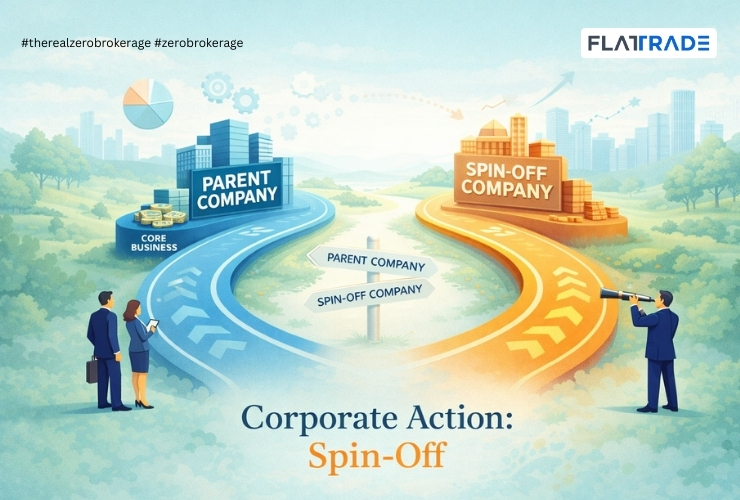
A spin-off is a corporate action that occurs when the parent company separates a part of its business to form a new and independent company. The company distributes shares of the new company to its existing shareholders, typically to unlock value, improve focus, and allow markets to independently price distinct businesses. Unlike dividends or buybacks, a spin-off does not involve the distribution of cash. Instead, it reshapes how a company’s businesses are owned and valued.
For example, Company A shares trade at ₹1,000 It spins off its subsidiary as Company B.
Post spin-off: Company A shares trade at ₹700 Company B lists at ₹300
Total value = ₹1,000, now split across two companies.
What is a Corporate Action?
A corporate action is an event initiated by a company that brings about significant changes in its securities and directly impacts shareholders. These may be either monetary benefits like dividends, interest, or non-monetary benefits like bonuses, rights, etc.
This action is implemented through stock exchanges such as the National Stock Exchange and the Bombay Stock Exchange.
Why Do Companies Undertake Spin-Offs?
Allows each of its businesses to focus on its core operations
Improve transparency and accountability
Unlock value that may be hidden within a diversified structure
Enable independent capital allocation and management strategies
A spin-off is often a strategic restructuring, not a sign of distress.
Impact of Spin Off
The combined Market Capitalisation of the parent company and the spin-off entity remains broadly unchanged at the time of the spin-off. Value is redistributed between two companies instead of one.
The face value usually remains the same unless it is altered by the company. Any change in face value is only structural and does not affect market value.
The number of shares of the parent company remains the same. Investors receive additional shares of the spin-off company based on the announced ratio.
On the ex-date, the parent company’s share price adjusts downward, and the spin-off company lists and trades independently. This price adjustment reflects the separation of businesses, not a loss.
The total investment value remains neutral initially, but over time, the value depends on how each company performs independently.
Impact on Futures and Options
Contract specifications are adjusted by the exchange
Strike prices and contract values are readjusted
Positions remain value-neutral after adjustment
All changes are handled by the exchange to ensure no unfair gain or loss.
How to Know About Spin-Offs in Advance?
Exchange circulars (NSE/BSE)
The Company board meeting disclosures
Corporate action calendars on trading platforms
Official company filings
Tracking these updates helps investors prepare for changes in holdings.
What is Record Date?
A record date is a pre-set cut-off day a which the company checks its official shareholder list to determine who is eligible to receive shares of the spin-off entity. Only investors holding shares as per the company records on this date will be eligible.
What is Ex-date?
The ex-date is the date on which the parent company’s stock trades without the spin-off entitlement. In India: Ex-date is usually one working day before the record date. Shares must be bought before the ex-date to be eligible for the corporate action.
How Is a Spin-Off Applied in Flattrade?
Spin-off shares are automatically credited to eligible investors.
No manual application is required.
Share price adjustments are reflected automatically on the ex-date
Spin-off shares appear in the demat account once listed.
At Flattrade, investors and traders have a hassle-free experience because your execution is seamless.