

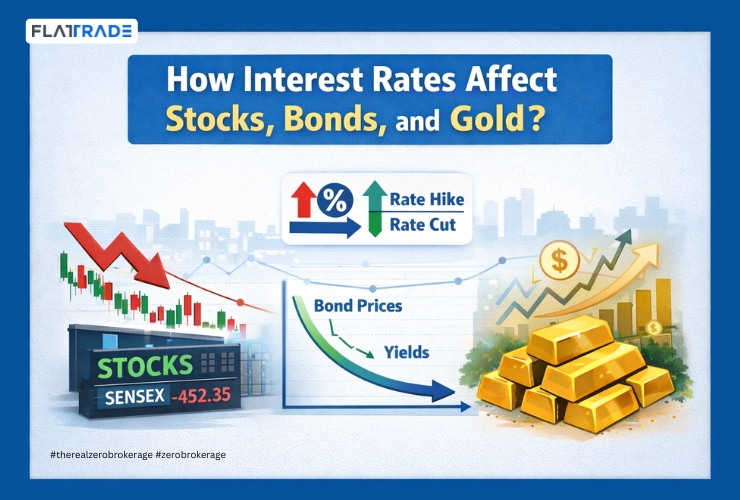
Interest rates are one of the most powerful forces in financial markets. Set by central banks like the Reserve Bank of India (RBI) and influenced by global conditions, rate changes affect almost every asset class -equities, bonds, and even gold.
Understanding how this works helps investors manage risk instead of reacting emotionally.
Why Interest Rates Matters?
Interest rates represent:
- The cost of borrowing
- The reward for saving
When rates change, they influence:
- Consumer spending
- Business investment
- Inflation expectations
- Currency movements
- Overall market sentiment
As a result, each asset class responds differently.
Interest Rates and Stocks
When Interest Rates Rise
- Borrowing becomes more expensive for companies
- Profit margins may shrink
- Consumers may reduce spending
- Future earnings are discounted at higher rates
- Investors may shift to fixed income for better yields
Result: Equity markets often face pressure or increased volatility.
Growth stocks are typically more sensitive to rising rates.
When Interest Rates Fall
- Cheaper borrowing encourages expansion
- Consumer spending improves
- Lower discount rates support valuations
- Liquidity increases
Result: Stocks often perform better, particularly rate-sensitive sectors like banking, real estate, and consumer discretionary.
Interest Rates and Bonds
Bonds have an inverse relationship with interest rates.
When Rates Rise
- New bonds offer higher yields
- Existing lower-yield bonds become less attractive
- Bond prices fall
When Rates Fall
- Existing higher-yield bonds become more valuable
- Bond prices rise
Key takeaway: Long-duration bonds are more sensitive to rate changes than short-term bonds.
Interest Rates and Gold
Gold does not generate interest or dividends. Its appeal depends largely on real interest rates and economic uncertainty.
When Rates Rise
- Savings and bonds offer better yields
- Opportunity cost of holding gold increases
- A stronger currency can weigh on prices
Result: Gold may face pressure.
When Rates Fall
- Opportunity cost declines
- Investors seek gold as an inflation hedge
- Safe-haven demand may rise
Result: Gold often benefits.
The Role of Inflation and Expectations
Markets are forward-looking.
They react not just to actual rate changes, but to expectations.
For example:
- Stocks may rally ahead of anticipated rate cuts
- Bonds adjust based on expected policy shifts
- Gold can rise if inflation outpaces rate hikes
Understanding expectations is often more important than reacting to headlines.
How Should Investors Respond?
Instead of reacting emotionally:
- Diversify across asset classes
- Understand duration risk in bonds
- Focus on earnings quality in equities
- Monitor inflation alongside rate decisions
Interest rates are neither good nor bad. They are signals about economic conditions.
Interest rates act like gravity in financial markets. They influence valuations, liquidity, and investor behaviour.
Rising rates may pressure risk assets but also create disciplined entry opportunities. Falling rates may boost markets, but they sometimes signal an economic slowdown.
Investors who understand the relationship between rates and asset classes make structured decisions.
Because in markets, clarity beats prediction.
Navigating Interest Rate Cycles with Flattrade
Interest rate cycles create movement across equities, bonds, and commodities. During such phases, access to the right tools becomes important.
Flattrade enables investors and traders to respond to changing rate environments with clarity:
- Real-time market tracking across asset classes
- Advanced charting tools for technical analysis
- Quick order execution during volatile phases
- Transparent real zero brokerage structure
- Easy access to equities, derivatives, commodities, and gold ETFs
When rate decisions trigger volatility, structured platforms help investors act based on analysis instead of noise.
Interest rates may influence markets, but disciplined execution and cost efficiency remain within your control.