


Buying shares today takes just a few seconds on a mobile phone. But before 1950, stock market investing in India was a slow, paper-based, and relationship-driven process. There were no online platforms, no electronic records, and no market regulator like SEBI.
Yet, India had one of the world’s oldest functioning stock markets, which played a crucial role in funding businesses and supporting early industrial growth.
The Birth of Indian Stock Trading
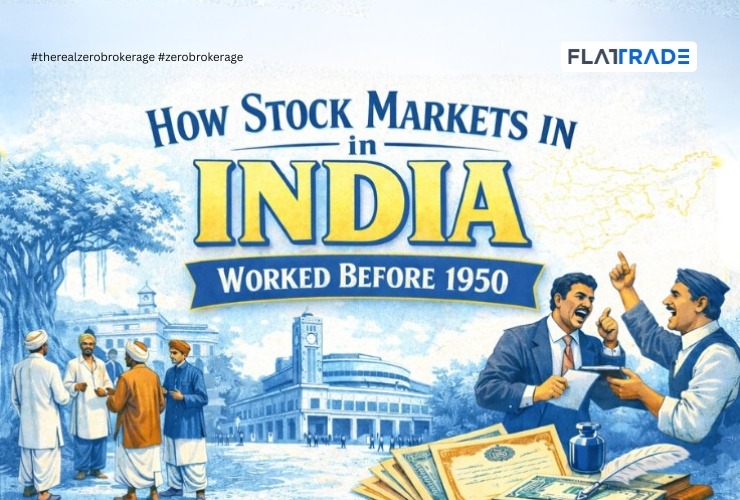
The origins of Indian stock trading can be traced back to the 1830s in Bombay (now Mumbai). During this time, a small group of brokers would gather under a banyan tree near the Town Hall area to trade shares of cotton trading companies.
Over time, these informal meetings became more organised. In 1875, the Bombay Stock Exchange was formally established, making it Asia’s oldest stock exchange.
Other regional exchanges soon followed:
- Calcutta Stock Exchange (1908)
- Madras Stock Exchange (1937)
- Delhi Stock Exchange (1947)
All trading during this period was conducted manually and depended heavily on trust, reputation, and personal relationships.
A Quick Timeline: Indian Stock Markets Before & After 1950
1830s
Informal share trading begins in Bombay, under a banyan tree near Town Hall.
1875
Formal establishment of the Bombay Stock Exchange, Asia’s oldest stock exchange.
1908 – 1947
Regional stock exchanges emerge:
Calcutta (1908), Madras (1937), Delhi (1947).
Pre-1950
Manual trading, open outcry system, handwritten contracts, and physical share certificates dominate the market.
1956
The Companies Act was strengthened to improve corporate governance.
1957
The Securities Contracts (Regulation) Act was introduced to regulate stock exchanges.
1992
Formation of the Securities Exchange Board of India brings centralised regulation and investor protection.
1996
Launch of the National Stock Exchange, introducing fully electronic trading.
From handwritten contracts to electronic trading, India’s stock markets have travelled a long way – shaped by experience, reform, and technology.
How Trading Actually Happened
Before 1950, there were no computers, demat accounts, or trading screens.
- Physical presence: Investors had to visit a broker’s office or the trading floor in person.
- Open outcry system: Traders shouted prices and used hand signals to place orders.
- Handwritten contracts: Once a deal was agreed upon, it was recorded on paper and signed by both parties.
- Slow settlement: Shares were delivered physically, and payments were made using cheques or cash.
A single trade could take 10 to 30 days to settle fully.
A Real Example from Early Markets
In 1907, Jamsetji Tata founded the Tata Iron and Steel Company (TISCO). To raise capital, the company issued physical share certificates to investors.
Wealthy families who invested in these early issues often held their certificates for decades, passing them down through generations. As Tata companies grew into major industrial giants, these early investors benefited significantly. This demonstrated that long-term investing can create wealth, even in the earliest and most imperfect markets.
Who Could Participate in the Market?
Stock market participation before 1950 was limited mainly to:
- Wealthy traders and business families
- Banks and financial institutions
- British officials and colonial enterprises
The general public had very limited access due to high costs, lack of information, and the absence of brokerage networks for small investors.
Absence of Market Regulation
Before 1950, India’s stock markets operated with minimal oversight:
- There was no central regulatory authority
- Insider trading was common
- Market manipulation occurred frequently
- Brokers could disappear with investor money
This environment often led to unethical practices and significant investor losses.
What Changed After 1950?
After Independence, the Indian government recognised the need for a regulated and transparent capital market. Several key reforms followed:
- 1956:Companies Act strengthened corporate governance
- 1957:Securities Contracts (Regulation) Act introduced
- 1992:Formation of Securities Exchange Board of India
- 1996:National Stock Exchange introduced electronic trading
These reforms transformed India’s capital markets into a modern, accessible, and technology-driven system.
India’s stock market before 1950 was built on trust, ambition, risk, and chaos. It was slow, exclusive, and often unsafe – but it laid the foundation for today’s transparent and regulated financial system.
Understanding how far the market has evolved offers a valuable perspective on why regulation, technology, and investor protection matter today.