


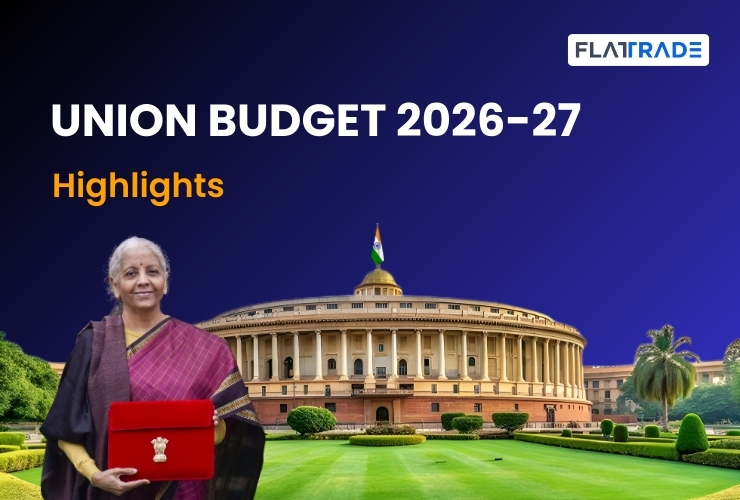
The Finance Minister, Nirmala Sitharaman, presented the Union Budget 2026-27 on February 1, 2026, outlining India’s fiscal roadmap for the coming financial year. Markets reacted with heightened volatility, driven by both expectations and policy announcements, making this Budget especially relevant for investors and traders.
Trading Cost Revisions
One of the most discussed changes for active market participants was the revision in transaction taxes:
- STT on equity futures revised from 02% to 0.05%
- STT on equity options premium revised from 0.10% to 0.15%
- STT on exercised options revised from 13% to 0.15%
Possible market implications:
- Higher transaction costs may affect net margins for active and derivatives traders
- Some reduction in short-term derivatives activity may occur as traders adjust strategies
- Trading volumes could see near-term recalibration as cost structures change
Share Buyback Tax Treatment Changes
The Budget introduced revisions to the taxation framework for share buybacks, shifting how proceeds are taxed between companies and investors.
Why this matters:
- Post-tax outcomes from buybacks may differ based on investor tax profile and holding period
- Companies may reassess buybacks versus dividends as capital return tools
- Investors should review updated rules and evaluate buyback opportunities with tax awareness
Capex Push and Infrastructure Focus
Capital expenditure remains a core priority. Infrastructure spending was budgeted at ₹12.2 lakh crore, up roughly 11% over the previous year.
Investor lens:
- Continued public capex may support sectors such as infrastructure, capital goods, construction, and logistics
- Long-term order flows and project pipelines could strengthen in these segments
Macro Signals for Bond and Equity Markets
Macro Signals for Bond and Equity Markets
The Budget estimated gross market borrowings of about ₹17.2 trillion and net borrowings of about ₹11.7 trillion to finance the fiscal deficit. The government indicated active debt management measures in coordination with the RBI.
Market angle:
- Higher borrowing levels can influence long-term interest rates
- Rate-sensitive sectors such as real estate, utilities, and financials may respond to bond yield movements
- Bond market stability generally supports equity market confidence
Impact on International Investors
The Budget also included measures aimed at improving foreign investor participation.
Key signals:
- Higher investment limits under certain portfolio routes
- Continued push for tax clarity and simpler structures
- Policy direction supportive of deeper global participation in Indian markets
Market Reaction on Budget Day
Budget day saw elevated volatility:
- Sensex and Nifty recorded sharp intra-day swings, with declines of roughly 5–2%at one stage
- Traders linked sentiment weakness partly to transaction tax revisions
- In the days following, indices recovered, with benchmark levels trading roughly 2–3% higherversus Budget-day lows, indicating post-announcement repricing
Closing Insights
The Union Budget 2026-27 delivered both short-term trading triggers and longer-term structural signals.
- For traders, the focus shifts to cost efficiency and position sizing awareness
- For investors, the capex and infrastructure push highlights sectoral themes worth tracking
- Policy direction suggests a continued move toward long-term growth and market deepening
As always, strategy should align with risk profile, time horizon, and tax considerations.