

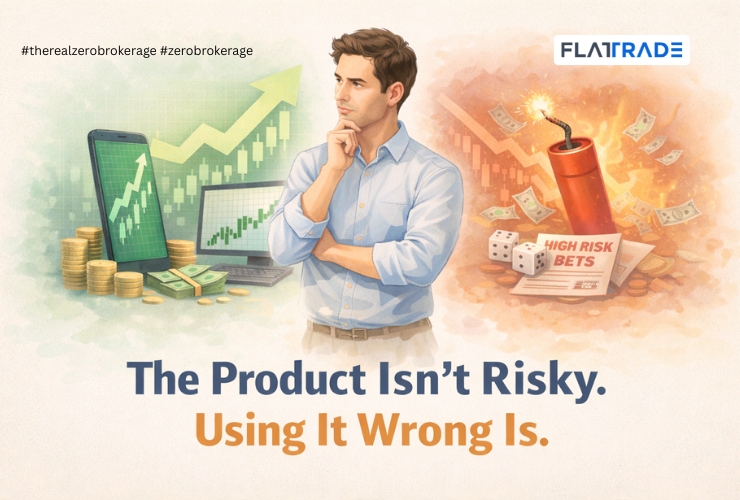
The product isn’t risky. Using it wrong is.
Aarav is the kind of market participant many of us recognise. Careful. Well-intentioned. Confident that choosing the right product is enough to manage risk.
He never chased shortcuts or overnight success. He stayed cautious around advanced market products and believed that sticking to well-known, regulated instruments automatically made his approach safe.
In his mind, popularity and accessibility meant lower risk. He didn’t imagine this assumption would later work against him.
In his initial trades, the market moved in his favour. The profits were small, but they were enough to reinforce his belief that the product itself was safe. Early success began to feel like understanding, even though favourable market conditions played a larger role than skill.

Encouraged by quick outcomes, Aarav increased his trade sizes without reassessing whether the opportunity justified it. He stopped defining clear exit points, trusting that the market would eventually turn his way. When losses appeared, he treated them as temporary setbacks rather than signals to pause and review.
The product did not change during this phase. Aarav’s behaviour did.
When the market moved against him, like many others, Aarav blamed the product. What he hadn’t realised was that risk rarely comes from the instrument alone. It enters when a product is used without understanding volatility, time horizon, or position sizing.
He had confused accessibility with simplicity. Just because a product is easy to access does not mean it is easy to use correctly.
After a series of losses, Aarav reviewed his trades objectively. Overleveraging stood out as a major mistake. He had entered positions without a clear plan, taken exposure beyond his risk capacity, and treated a structured financial product like a shortcut instead of a tool.
The same product he once believed was safe had produced completely different outcomes, based entirely on how it was used. This review helped him see an uncomfortable truth. Blaming the product was easier than examining his own decisions.
Over time, Aarav changed his approach.
He began defining risk before returns. He decided how much he was willing to lose before entering a trade. He matched products to objectives instead of forcing objectives onto products. Most importantly, he accepted that choosing not to use a product was also a valid decision.
The product did not become safer. Aarav became more responsible.
The lesson from Aarav’s story is simple, but often ignored. Financial products are tools, not sources of risk by themselves. Risk arises when they are misunderstood, overused, or applied without a plan.
Markets do not punish complexity. They punish misuse.
Even simple products can be risky when handled without clarity, while advanced tools can be effective when used with discipline. Risk does not come from the product label. It comes from ignoring how the product works.
Today, Aarav approaches every product with one question in mind:
Do I understand this well enough to use it responsibly?
Because in investing, the product isn’t risky.
Using it the wrong way is