



For today’s students, the stock market is no longer something distant or intimidating. It’s accessible, digital, and just a few clicks away. With modern trading platforms, low starting capital, and unlimited learning resources online, participating in the markets has become easier than ever before.
But easy access doesn’t guarantee meaningful results.
The market still rewards preparation over excitement, discipline over impulse, and consistency over shortcuts. Many beginners step in driven by curiosity or quick-profit stories, only to realize that sustainable progress demands structure and self-control.
The true advantage students have today is time. Starting early allows you to build habits, understand market behavior, and develop decision-making discipline without immediate financial pressure. Small beginnings, steady learning, and thoughtful planning can gradually shape confidence and competence.
When approached with patience and clarity, trading transforms from a thrill into a skill.
Why Students Should Learn Trading Early?
Starting early gives students an edge that money alone cannot buy, which is time and learning flexibility.
- Understanding how money grows and compounds
- Learning risk and decision-making skills
- Developing discipline and patience
- Gaining real-world financial awareness beyond textbooks
- Flexibility to experiment with small capital
- Faster learning curve with digital tools
Unlike full-time traders, students can focus on skill-building first, profit later.
Step 1: Build Market Basics
Before placing any order, students should understand core concepts:
- What is a stock, index, ETF, or derivative
- Difference between investing and trading
- How prices move (demand&supply, news, sentiment)
- Basics of charts and price action
- Order types (market, limit, stop loss)
Students and newcomers should avoid shortcut learning from random social media tips and build structured knowledge first.
Rule: Learn → Observe → Practice → Trade.
Students can start with Mock trading, practice without real money, while learning about market behavior, order execution, and review results. This builds analytical thinking without financial risk.
Step 2: Use a Beginner-Friendly Platform
When choosing a trading platform, it should be made sure the platform is simple and easy to use, without any complicated processes. Clean interface, easy order placement, and budget-friendly cost structure matter a lot for students.
This is where Flattrade comes in. Here is why it works well for first-time traders:
- Beginner-friendly interface
- Account opening in 5 just minutes
- Easy order placement across segments
- Simple dashboard and chart tools
- Suitable for equity, F&O, IPOs, mutual funds, and more, all in one place
- Zero Brokerage on all trades
Many student traders ignore brokerage costs, but they quietly eat into small capital accounts. That’s why pricing structure matters. Flattrade offers zero brokerage across all segments on all trades.
Lower cost = more room to learn.
Step 3: Start Small, Trade Slower
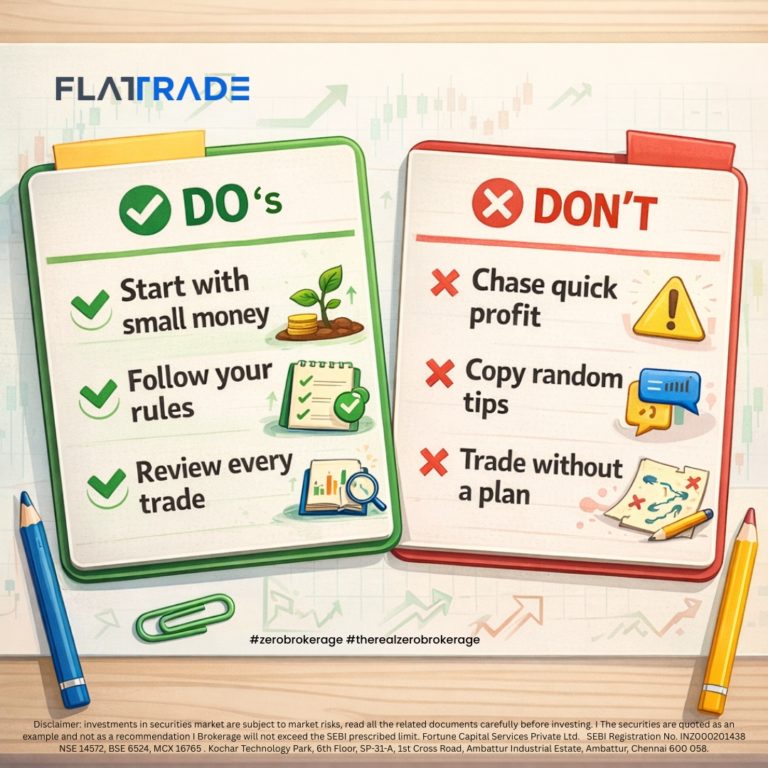
When moving from practice to real markets, the first goal shouldn’t be income; it should be learning. Students should choose a small amount of capital, which they are okay with experimenting. Students should remember certain things to learn the trading flow, which includes trading in small quantities, taking only clear setups, always defining your stop loss before entering a trade, avoiding leverage (borrowed funds) in the beginning, and keeping the trade count low so the focus can be on decision quality instead of speed or excitement.
Step 4: Follow simple strategy
Students often make the mistake of jumping between strategies daily. They should,
- Avoid strategy overload.
- Support and resistance trading
- Breakout strategy
- Moving average crossover
- Stick to one approach and test it over multiple trades.
Students can improve faster when they go deep instead of wide.
Step 5: Track Every Trade
Students can maintain a trading journal with:
- Entry price
- Exit price
- Reason for trade
- Chart setup
- Outcome
- Emotional state
- Review weekly.
Students who journal improve faster because they convert mistakes into lessons.
Step 6: Avoid the Trading Traps
New student traders often fall into predictable traps like,
- Trading based on social media tips
- Copying influencer trades
- Overtrading out of excitement
- Doubling down after losses
- Using borrowed money
- Expecting daily income from markets
Markets reward patience and process, not instinct.
Start Early, But Start Right
The journey from classroom to market should be about learning ,not about speed. In the early stages, the emphasis must remain on mastering the craft: refining strategy, strengthening process quality, maintaining capital discipline, and building emotional stability. Skill must come first. Earnings must follow as a natural outcome.
When competence is developed patiently, confidence grows organically. And when confidence is earned through structure and consistency, progress becomes sustainable.
Today’s students have access to tools and platforms that previous generations never experienced. With sound knowledge, modest capital, a disciplined framework, and a beginner-friendly zero-brokerage platform like Flattrade, the pathway to market participation is more accessible than ever.
And that is how a student evolves into a market professional, the right way.