

We’re operating in a world where data is everywhere.
But here’s the real challenge.
Having data is one thing.
Making sense of it is another.
Relying only on instinct can often lead to inconsistent decisions.
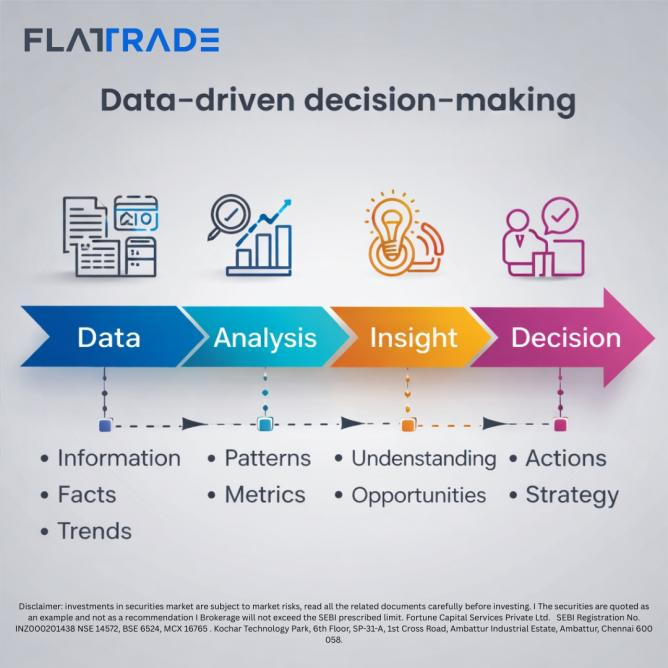
What tends to work better is a structured, data-backed approach.
That’s where analytical tools come in.
They help turn raw information into clear insights, making decision-making more informed, consistent, and effective.
What Are Analytical Tools?
Analytical tools are software applications or methods used to collect, process, and interpret data.
They help identify:
- Patterns
- Trends
- Relationships within large datasets
Instead of manually analysing information, these tools simplify the process and make insights easier to understand.
In financial markets, they allow investors and traders to analyse price movements, compare opportunities, and assess potential risks.
Modern platforms like Flattrade provide access to charts, historical data, and analytical features that support this process.
Turning Data into Clear Insights
Large volumes of data can be difficult to interpret.
Analytical tools simplify this by presenting information in a more visual and structured way.
Instead of raw data, users get:
- Charts and price graphs
- Interactive dashboards
- Trend comparisons
- Performance reports
For example:
- Businesses track sales and customer behaviour using dashboards
- Investors analyse stock performance and portfolio trends
This makes it easier to move from information to understanding.
Supporting Data-Driven Decisions
Decisions made without structure can often be influenced by bias or incomplete information.
Analytical tools reduce this uncertainty by providing data-backed insights.
They help decision-makers:
- Analyse historical patterns
- Evaluate different scenarios
- Make more consistent choices
For investors, this means looking beyond short-term noise and making decisions with better context.
Improving Speed and Efficiency
Speed matters, especially when dealing with large datasets or market movements.
Analytical tools significantly reduce the time required to process information.
They can:
- Generate reports instantly
- Highlight key metrics
- Detect unusual patterns
- Provide real-time insights
For investors and traders, access to real-time data through platforms like Flattrade helps in responding more efficiently to market changes.
Forecasting Trends
Many analytical tools go a step further by offering predictive insights.
Using historical data and statistical models, they help estimate potential future outcomes.
For example:
- Businesses forecast demand or growth trends
- Companies identify emerging opportunities
- Investors assess possible market scenarios
While forecasts are not guarantees, they provide useful direction for planning.
Enhancing Risk Awareness
Another important role of analytical tools is in understanding and managing risk.
They help identify potential warning signals by analysing past data and current trends.
In financial markets, this can include:
- Monitoring volatility
- Comparing asset performance
- Evaluating portfolio exposure
- Identifying potential downside risks
With better visibility, decision-making becomes more measured and less reactive.
Conclusion
Analytical tools have become an essential part of modern decision-making.
They bring clarity to complex data, improve speed, and support more structured thinking.
In financial markets, they help investors and traders evaluate opportunities with greater awareness and consistency.
With platforms like Flattrade offering access to market data and analytical features, decision-making is becoming more accessible and informed.
As data continues to grow, the ability to interpret it effectively will only become more important.