
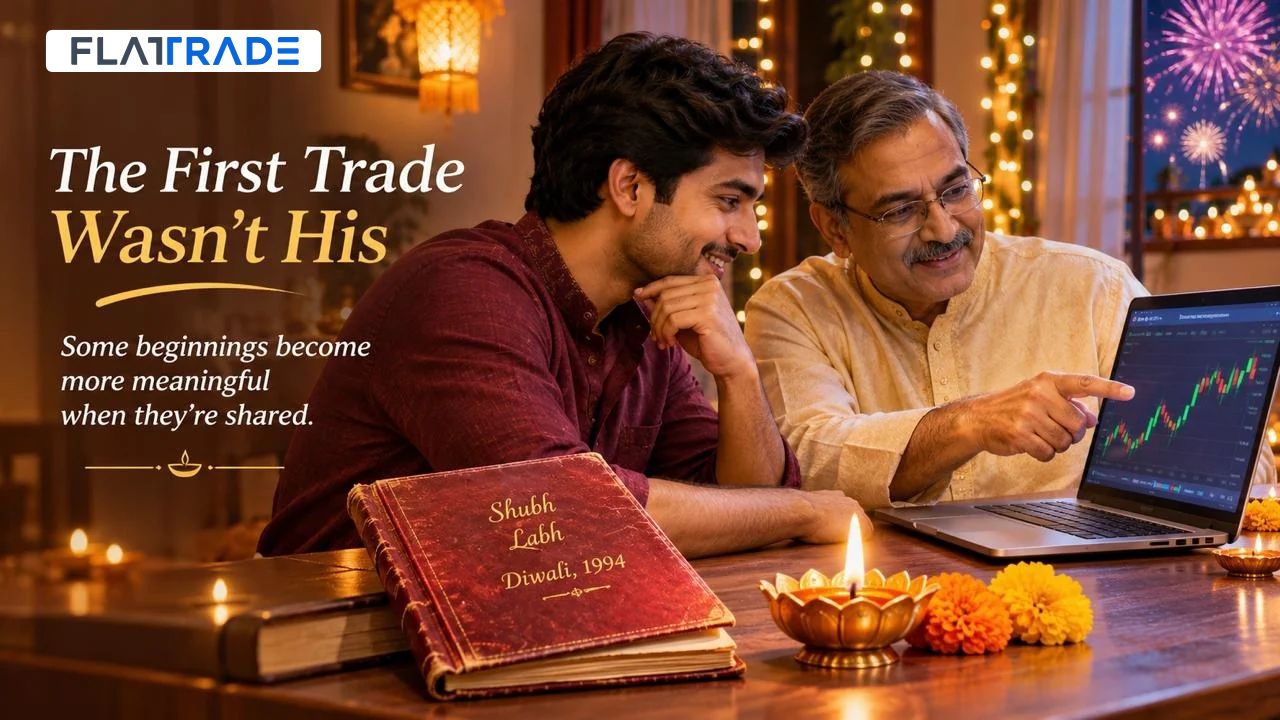

The First Trade Wasn’t His
Some beginnings become more meaningful when they’re shared.
The house smelled of fresh jasmine, sandalwood and the unmistakable sweetness of homemade Diwali sweets.
It was the Saturday before Diwali, and twenty-seven-year-old Arjun had been given a task he had successfully avoided for several years.
“Clean the cupboard in the study,” his father had instructed. “And don’t just move everything from one shelf to another like last time.”
Arjun laughed. His father, Srinivasan, had always been particular about two things: keeping his accounts in order and making sure the family celebrated Diwali together.
As Arjun pulled out old files and dusty folders, a small red notebook slipped from between two books.
Its cover was faded. The pages had turned yellow. On the first page, written carefully in blue ink, were the words:
Shubh Labh. Diwali, 1994.
“Appa, what’s this?” Arjun called out.
Srinivasan walked into the room, adjusted his glasses and stopped.
For a moment, he said nothing.
Then he smiled.
“Ah. I wondered where that had gone.”
He took the notebook from Arjun’s hands and sat down.
“Your grandfather gave me this on my first Diwali after I started working.”
“A diary?”
“Not exactly. My first investment ledger.”
Arjun looked puzzled.
“You maintained your investments in a notebook?”
His father laughed.
“We didn’t have trading apps, mobile notifications or charts on our phones. We had newspapers, brokers, telephone calls and a great deal of patience.”
He turned a few pages.
There were dates, company names, quantities and amounts. Some entries had been crossed out. Others had small handwritten notes beside them.
“Your grandfather believed Diwali was a good time to begin something meaningful,” Srinivasan continued. “Every year, he would perform a small puja for his account books. He called it the beginning of a new financial chapter.”
“Did he make a lot of money?”
Srinivasan shook his head.
“Sometimes he made money. Sometimes he lost it. But he never confused an auspicious beginning with a guaranteed outcome.”
Arjun looked up.
“Then why was it so important to him?”
“Because the occasion reminded him to begin with intention. And to take responsibility for what came next.”
That evening, as the family prepared diyas for the balcony, Arjun returned to the subject.
“Appa, I’ve been meaning to ask you something.”
Srinivasan looked up from the newspaper.
“That sounds serious.”
“I’ve started earning properly now. I’ve been saving every month. A few of my friends have started investing, and I’ve been thinking about it too.”
“Good.”
“But I don’t know where to begin.”
His father folded the newspaper.
“That’s a better starting point than pretending you know everything.”
Arjun smiled.
“One friend keeps sending me stock recommendations. Another says I should start trading immediately. Everyone seems to have an opinion.”
“And what do you think?”
“That’s the problem. I don’t know enough to have one.”
Srinivasan leaned back.
“When I was your age, your grandfather introduced me to the markets. He didn’t tell me which stock would double. He didn’t promise I’d become rich. He simply sat beside me and explained how businesses worked, why prices changed and why I should never put money into something I didn’t understand.”
Arjun listened.
“Then he made me write down my reasons before every investment.”
“That sounds like a lot of work.”
“It was,” his father replied. “That’s probably why it helped.”
For the next hour, they spoke about the markets.
Not about hot tips or overnight profits.
They discussed risk, patience, diversification and the difference between investing and trading. Srinivasan explained that even a carefully considered decision could go wrong, and that understanding one’s financial circumstances mattered more than following someone else’s excitement.
At one point, Arjun asked the question his father had been expecting.
“So, what should I buy first?”
Srinivasan smiled.
“Before you decide what to buy, learn why you’re buying it.”
Arjun fell silent.
It was not the answer he had hoped for.
But perhaps it was the answer he needed.
The following morning, Arjun found his father sitting at the dining table with his laptop.
“What are you doing, Appa?”
“Looking at the Muhurat Trading schedule.”
“Muhurat Trading?”
“You’ve heard of it?”
“Of course. But I never understood why the stock market opens on Diwali.”
Srinivasan explained how Muhurat Trading had become a cherished tradition in India’s financial markets, reflecting the belief that Diwali marks a time for fresh beginnings.
“It’s a special trading session,” he said. “But remember, the market doesn’t become less risky just because the occasion is auspicious.”
Arjun nodded.
“So you still follow it every year?”
“Whenever I can. Sometimes I participate. Sometimes I simply watch. It reminds me of your grandfather.”
There was a brief silence.
Then Srinivasan turned the laptop towards his son.
“Would you like to learn how to open your own account?”
Arjun looked surprised.
“You’re finally letting me into your secret world?”
“There is no secret world,” his father laughed. “Only things you haven’t learned yet.”
Together, they went through the account-opening process on Flattrade. Srinivasan explained the information being requested, the importance of reading the terms and the need to understand the platform before placing any orders.
Arjun completed the required steps and submitted his application for verification.
For the first time, the markets felt less like a confusing collection of numbers and more like something he could gradually understand.
On Sunday, 8 November, the family gathered for Diwali.
There were sweets on the table, lamps along the balcony and the familiar sounds of relatives calling to exchange wishes.
In the study, Srinivasan had placed the old red notebook beside his laptop.
Arjun noticed it immediately.
“Still using that?”
“Not for transactions,” his father said. “For memories.”
They sat together as the special Muhurat Trading session approached.
Arjun’s account-opening application was still being processed, so he would not be placing a trade that day.
To his own surprise, he wasn’t disappointed.
Instead, he watched his father explain the market movements, the orders appearing on the screen and the decisions a participant needed to consider before trading.
There was no rush.
No excitement about finding the next big winner.
Just a father sharing what he knew with his son.
After a while, Arjun picked up the red notebook.
“Appa, can I borrow this?”
His father raised an eyebrow.
“Planning to trade using a notebook?”
“No,” Arjun laughed. “I want to write something on the last page.”
He found a blank page and wrote:
Diwali, 2026.
Today, I began learning about the markets with Appa.
My first investment is still ahead of me.
But my journey has already begun.
He handed the notebook back.
Srinivasan read the words slowly.
For a moment, his eyes lingered on the page.
Then he closed the book and placed his hand on Arjun’s shoulder.
“Your grandfather would have liked that.”
Outside, the first diyas had begun to glow.
And in that quiet little room, a tradition had found its way into another generation.
Not through a stock recommendation.
Not through a promise of wealth.
But through something far more meaningful.
Someone taking the time to show another person where to begin.
The Lesson Behind the Story
Muhurat Trading is more than a special market session. For many families, it represents continuity, optimism and the tradition of welcoming a new financial chapter.
But the true value of a new beginning lies in how thoughtfully we approach it.
- Share knowledge, not promises:Introducing someone to the markets should begin with education, not predictions of guaranteed profits.
- Every journey has its own pace:Opening an account, understanding risks and learning how markets work are meaningful first steps. There’s no need to rush into a trade.
- Traditions become stronger when shared:Sometimes, the most valuable thing we can pass on isn’t an investment. It’s the knowledge and confidence to make informed decisions.
An auspicious occasion can inspire a beginning. What happens next depends on the choices we make.
Wednesday Reminder
“The best beginnings aren’t always the ones we make for ourselves. Sometimes, they’re the ones we help someone else make.”
This Diwali, share the spirit of a new beginning.