

Futures and Options (F&O) are derivative contracts that may sound complex at first. Terms like leverage, margin, and expiry can feel intimidating for new traders.
However, once you understand the basics, F&O trading becomes easier to navigate. These instruments are commonly used by traders to hedge risks, speculate on price movements, or enhance trading strategies.
This guide explains the basics of futures and options trading for beginners and the key concepts every new derivatives trader should know.
What Are Futures and Options?
Futures and Options (F&O) are derivative contracts that allow traders to buy or sell an underlying asset at a predetermined price at a future date. These contracts derive their value from assets such as stocks, indices, or commodities.
F&O trading is widely used in financial markets for risk management, speculation, and strategic trading.
In the equity market, the two most common derivatives are:
- Futures Contracts
- Options Contracts
What Are Derivatives?
A derivative is a financial contract whose value is derived from an underlying asset such as a stock, index, or commodity.
Derivatives allow traders to:
- speculate on future price movements
- hedge against potential losses
- lock in prices for a future date
In India, derivatives trading is a significant part of the stock market, with Futures and Options being the most widely traded instruments.
What Are Futures?
A Futures contract is an agreement to buy or sell an underlying asset at a predetermined price on a specified future date.
The underlying asset can be a:
- stock
- index
- commodity
- financial instrument
Example
Suppose a stock is currently trading at ₹1,000, and you expect its price to rise.
You buy a futures contract at ₹1,000.
If the price increases to ₹1,050, you gain ₹50 per share (multiplied by the contract quantity).
However, if the price falls, the loss is also multiplied by the contract quantity.
What Are Options?
An Options contract gives the buyer the right, but not the obligation, to buy or sell an asset at a specified price before or on the expiry date.
There are two types of options.
Call Option
A Call option is purchased when a trader expects the price of an asset to rise.
Put Option
A Put option is purchased when a trader expects the price of an asset to fall.
The value of an option typically depends on factors such as:
- the price of the underlying asset
- time remaining until expiry
- market volatility
- interest rates
Key Terms Every F&O Beginner Should Know
Understanding a few key terms can make derivatives trading much easier.
Lot Size
The minimum number of shares or units per derivatives contract.
Margin
The capital required to enter and maintain a derivatives position.
Premium
The price paid to purchase an option contract.
Expiry Date
The last trading day of the derivatives contract.
Open Interest
The total number of active derivative contracts currently open in the market.
Why Do Traders Use F&O?
Traders use futures and options for several purposes.
Hedging
Investors hedge existing stock holdings to protect against potential losses.
Leverage
F&O trading allows traders to take larger positions with lower capital.
Trading Market Movements
Traders can benefit from both rising and falling markets.
Strategy Diversification
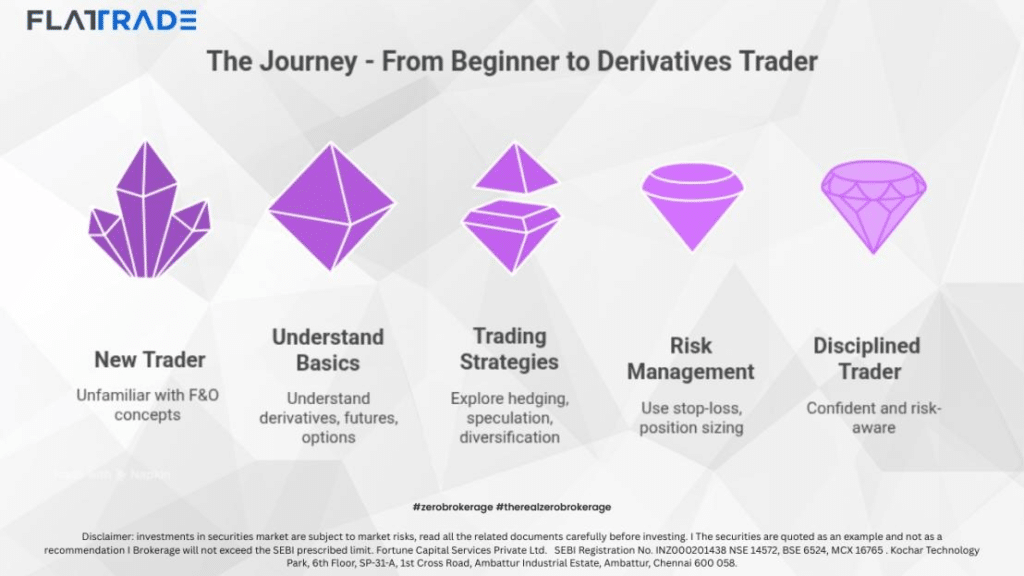
Derivatives help traders apply advanced strategies to manage risk and returns.
However, it is important to remember that leverage can amplify both profits and losses.
How to Start F&O Trading?
If you are new to derivatives trading, the process usually involves a few basic steps.
- Open a trading and demat account with a registered broker
- Activate the derivatives segment in your trading account
- Understand contract specifications and margin requirements
- Analyse market trends using charts and indicators
- Start with smaller positions while building experience
A structured approach helps beginners gradually understand futures and options trading without taking excessive risk.
Getting Started with F&O on Flattrade
For traders exploring derivatives markets, having the right trading platform is important.
Flattrade provides a structured environment for F&O trading with zero brokerage across trades. This allows traders to focus more on strategy and less on transaction costs.
Key platform features include:
- real-time market data
- advanced order types
- transparent margin visibility
- fast execution across web and mobile platforms
With these tools, traders can track contracts, analyse charts, and execute trades efficiently.
Key Tips for First-Time F&O Traders
Derivatives trading can offer opportunities, but disciplined practices are essential.
Here are some important guidelines for beginners:
- Learn contract specifications before trading
- Understand margin requirements clearly
- Avoid excessive leverage
- Use stop-loss orders to manage risk
- Follow proper position sizing based on your risk tolerance
Successful derivatives traders focus not only on returns but also on capital protection and risk management.
Futures and Options are powerful financial instruments. Traders who approach them with proper knowledge, disciplined execution, and strong risk awareness are better positioned to navigate market volatility.
Start small.
Learn continuously.
Trade responsibly.
With the right approach and a reliable platform like Flattrade, traders can explore derivatives trading with greater clarity and confidence.