
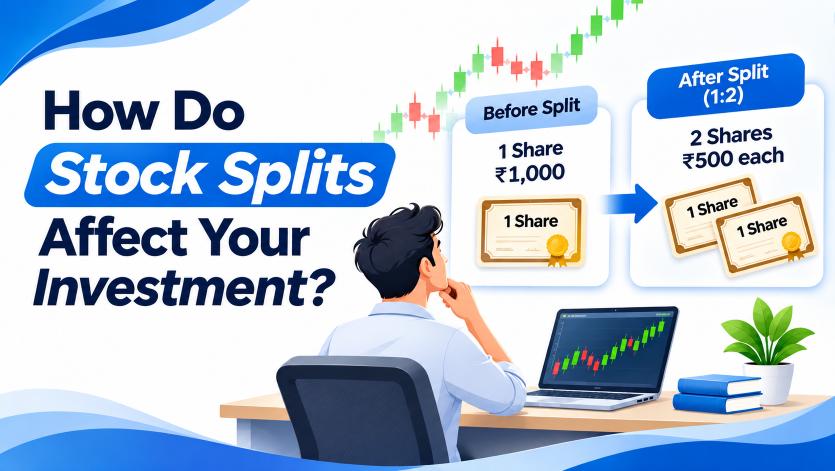
A stock split is a corporate action where a company increases the number of its outstanding shares by dividing each existing share into multiple shares. While the number of shares you own increases, the total value of your investment remains the same immediately after the split.
How Does a Stock Split Work?
Suppose you own:
- 100 shares priced at ₹1,000 each
- Total investment value = ₹1,00,000
If the company announces a 2-for-1 stock split:
Before Split | After 2:1 Split |
Shares: 100 | Shares: 200 |
Price per share: ₹1,000 | Price per share: ₹500 |
Total Value: ₹1,00,000 | Total Value: ₹1,00,000 |
Although your share count doubles, each share is worth half as much, leaving your investment value unchanged.
Why Do Companies Split Their Stock?
Companies may announce a stock split to:
- Make shares more affordable for retail investors.
- Improve trading liquidity.
- Increase investor participation.
- Signal confidence after strong business performance.
A stock split, however, does not change the company’s earnings, assets, debt, or overall business fundamentals.
What Changes After a Stock Split?
- You receive more shares.
- The share price adjusts proportionally.
- Your cost per share is adjusted.
- The company’s face value per share changes.
What Doesn’t Change?
- Your total investment value (immediately after the split).
- Your ownership percentage in the company.
- The company’s market capitalization.
- The company’s financial performance and fundamentals.
Is a Stock Split Good for Investors?
A stock split is generally viewed as a positive signal because it often follows a period of strong stock performance. It can attract more investors by lowering the share price and improving liquidity. However, a stock split alone does not make a company more valuable or guarantee higher future returns. Investment decisions should be based on the company’s fundamentals rather than the split announcement.
Final Thoughts
A stock split changes how your investment is divided – not how much it is worth. You’ll own more shares at a lower price per share, while your overall investment value remains the same immediately after the split. As always, focus on the company’s long-term business performance rather than corporate actions alone.