

The way traders engage in the market has changed as a result of algorithmic trading. Traders can now create strategies that automatically execute trades based on predetermined rules rather than manually placing trades based on intuition.
However, it is crucial to determine whether a trading strategy is effective before implementing it in the live market. Backtesting is essential in this situation.
What is Backtesting in Algo Trading?
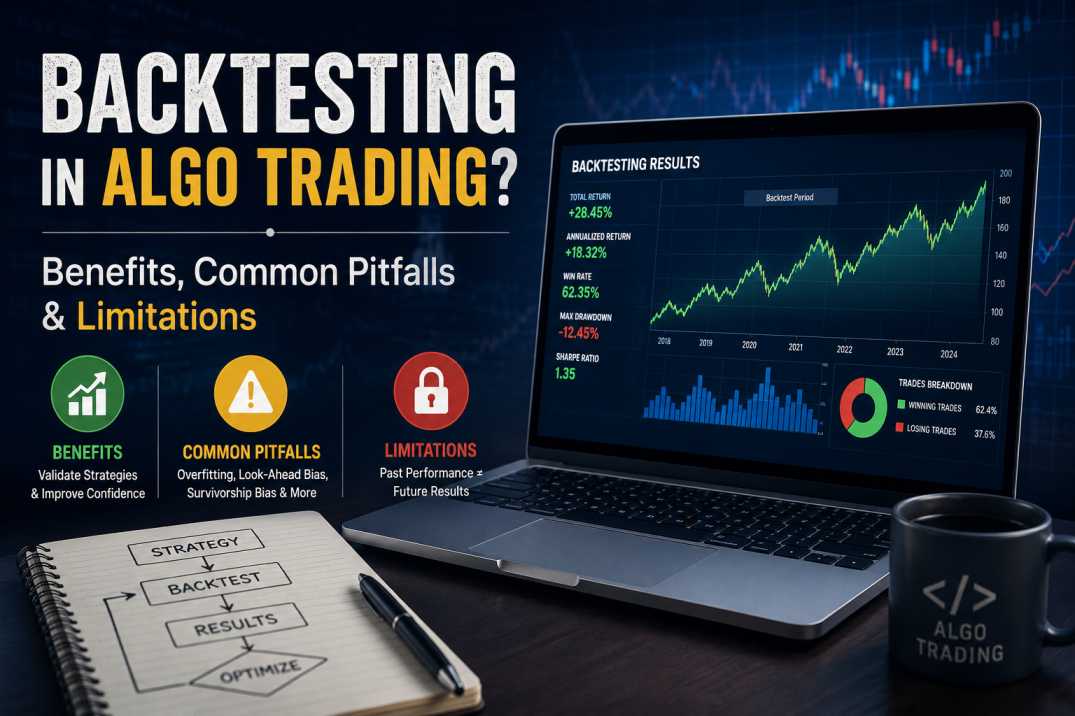
Backtesting is the process of testing a trading strategy using historical market data to evaluate how the strategy would have performed in the past.
In simple terms, backtesting answers a key question:
“If I had used this strategy in the past, would it have been profitable?”
A trading algorithm applies predefined rules such as:
Entry conditions
Exit conditions
Stop-loss levels
Position sizing
Risk management rules
The strategy is then run on historical price data to simulate trades and calculate performance metrics like:
Profit and Loss (P&L)
Win rate
Maximum drawdown
Risk–reward ratio
Sharpe ratio
Backtesting helps traders understand whether a strategy has a statistical edge before risking real capital.
Example of Backtesting
Let’s consider a simple strategy:
Strategy Rule:
Buy when the 50-day moving average crosses above the 200-day moving average.
Sell when the 50-day moving average crosses below the 200-day moving average.
If you run this strategy on historical data of a stock or index, the backtesting engine will simulate every trade that would have occurred based on those rules.
The result might show:
Total trades executed
Winning vs losing trades
Total return
Maximum drawdown
Profit factor
This helps traders determine whether the strategy is worth deploying in the live market.
Why Backtesting is Important in Algorithmic Trading
Backtesting is one of the most important steps in developing an algo trading strategy.
Without backtesting, traders are essentially trading blindly.
Here are some key reasons why backtesting matters:
1. Validates Trading Strategy
Backtesting helps determine whether a strategy has historically generated profits or if it fails under certain market conditions.
It provides evidence instead of relying on assumptions.
2. Improves Strategy Optimization
Traders can tweak strategy parameters such as:
- Moving average periods
- Stop loss levels
- Position sizing
By testing multiple variations, traders can optimize their strategies before live deployment.
3. Helps Understand Risk
Backtesting reveals critical risk metrics like:
- Maximum drawdown
- Losing streaks
- Volatility of returns
This helps traders decide whether they can emotionally and financially handle the strategy.
4. Builds Confidence
A well-tested strategy builds trader confidence.
Knowing that a strategy has performed well over multiple years of historical data makes it easier to trust the system during real trading.
5. Saves Capital
Testing strategies before live deployment helps traders avoid costly mistakes.
Instead of learning through losses, traders can identify weaknesses through historical simulation.
Benefits of Backtesting
Backtesting offers several advantages for both beginner and experienced traders.
Data-driven decision making
Backtesting removes emotional bias and replaces it with quantitative analysis.
Faster strategy evaluation
Instead of waiting months or years to see if a strategy works, traders can evaluate years of performance within minutes.
Identifies market behavior
Backtesting shows how strategies behave during:
- Bull markets
- Bear markets
- Sideways markets
- High volatility periods
This helps traders understand the robustness of their strategies.
Performance metrics
Most backtesting platforms provide detailed performance metrics including:
- Profit factor
- Sharpe ratio
- Maximum drawdown
- CAGR
- Trade distribution
These metrics help evaluate whether the strategy is reliable or risky.
How Qubit Helps Traders Backtest Strategies
Modern platforms have made strategy building and backtesting much easier.
Qubit by Flattrade allows traders to build and test algorithmic trading strategies without writing any code.
Key features include:
- No-code strategy builder – create strategies visually without programming knowledge
- Backtest strategies using 6+ years of historical data
- Minute-by-minute historical market data for accurate strategy testing
- Test multiple strategies quickly before live deployment
This enables traders to validate strategies using detailed historical data and improve their trading systems before risking capital.
With access to minute-level data for more than Six years, traders can analyze how strategies perform across different market cycles.
Backtesting is a critical step in developing successful algorithmic trading strategies.
It helps traders evaluate strategies using historical data, measure risk, and optimize trading rules before deploying them in the live market.
However, traders must also understand the pitfalls and limitations of backtesting, including overfitting, data bias, and unrealistic assumptions.
Modern platforms like Qubit by Flattrade make it easier for traders to build and test strategies with no coding required, while leveraging 5+ years of minute-level historical data to simulate market conditions more accurately.
By combining proper backtesting, risk management, and disciplined execution, traders can significantly improve their chances of success in algorithmic trading.