

If you’ve ever looked at an options chain and seen a long list of numbers next to words like “CE” and “PE,” you’ve already seen strike prices in action. It’s one of the first terms every options trader needs to understand, because almost everything else about an option – its price, its risk, and its payoff – is built around it.
This article explains what a strike price is, how it relates to the price of the underlying asset, and why it matters before you place an options trade.
What Is Strike Price?
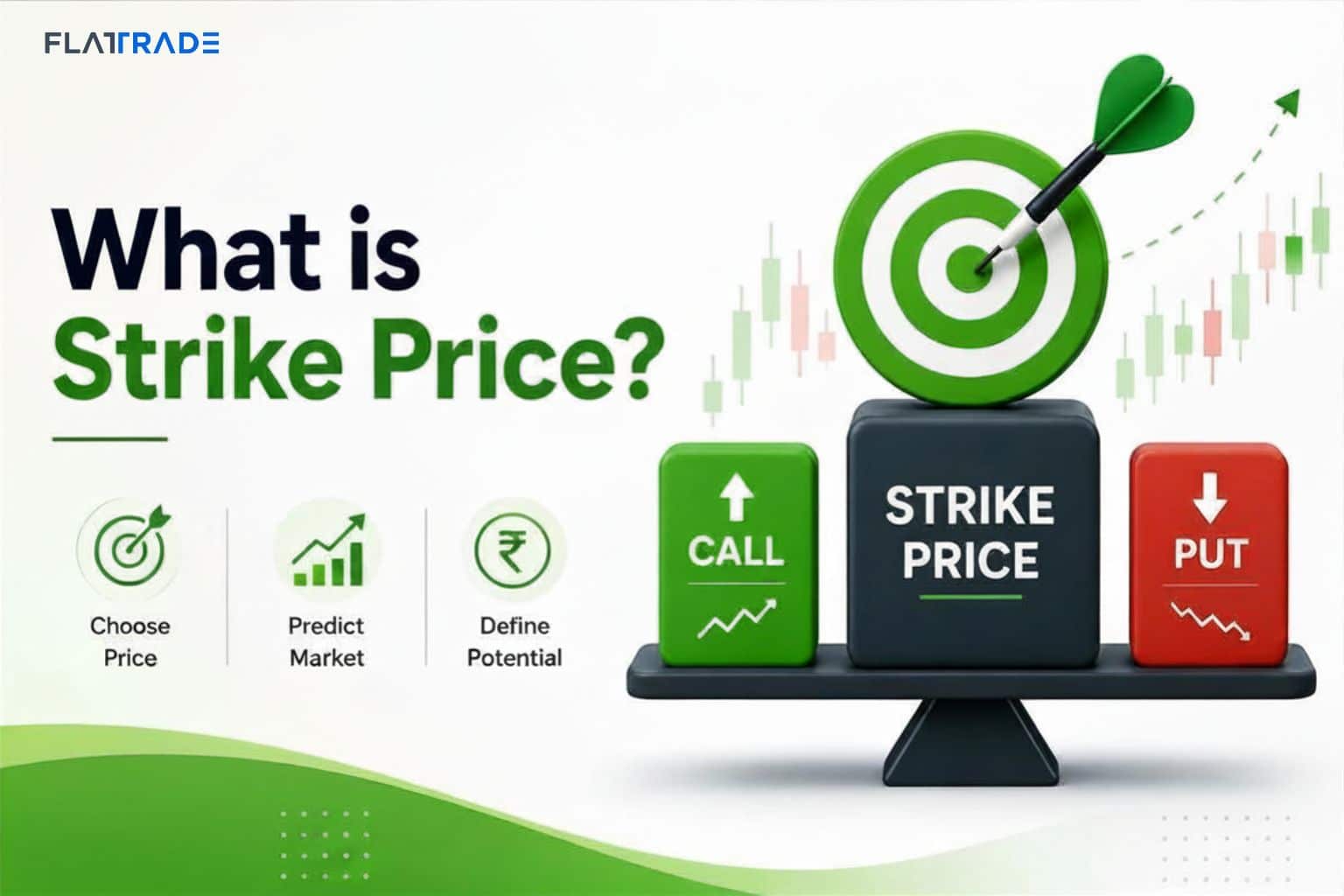
The strike price (also called the exercise price) is the fixed price at which an options contract allows the buyer to either buy or sell the underlying asset, depending on the type of option.
- In a call option, the strike price is the price at which the buyer has the right to buy the underlying asset.
- In a put option, the strike price is the price at which the buyer has the right to sell the underlying asset.
This price is fixed when the contract is created and does not change, even as the market price of the underlying asset (called the spot price) moves up or down until expiry.
Why Is Strike Price Important?
- It determines the option’s payoff. Whether an option is profitable at expiry depends on where the spot price ends up relative to the strike price.
- It affects the option’s premium. Strike prices closer to the current spot price are generally priced differently from strike prices far away from it.
- It defines your risk and strategy. Choosing a strike price is one of the key decisions in any options strategy, alongside expiry date and option type.
- It helps you understand “moneyness.” Strike price, compared to spot price, tells you whether an option is in-the-money, at-the-money, or out-of-the-money – concepts that are central to options trading.
How Does Strike Price Work?
The relationship between the strike price and the spot price of the underlying asset determines an option’s “moneyness.” This is usually described using three terms:
| Term | For a Call Option | For a Put Option |
|---|---|---|
| In-the-Money (ITM) | Spot price is above the strike price | Spot price is below the strike price |
| At-the-Money (ATM) | Spot price is approximately equal to the strike price | Spot price is approximately equal to the strike price |
| Out-of-the-Money (OTM) | Spot price is below the strike price | Spot price is above the strike price |
Generally speaking, ITM options tend to have higher premiums because they already have some “intrinsic value,” while OTM options tend to have lower premiums since they currently have no intrinsic value – only time value based on the possibility that the spot price could move favourably before expiry. This is a general concept and actual premiums depend on multiple factors, including volatility, time to expiry, and market conditions.
Example
Here is a simplified, illustrative example using round numbers only to explain the concept – not real market data or a trade recommendation.
Suppose a stock is currently trading at ₹100 (spot price). A trader buys a call option with a strike price of ₹105.
- If, at expiry, the spot price is ₹95, the option is out-of-the-money, since the strike price (₹105) is above the spot price. The option may expire worthless, and the trader’s loss is generally limited to the premium paid.
- If, at expiry, the spot price is ₹115, the option is in-the-money, since the spot price is above the strike price. The trader may benefit from the difference, though the net outcome also depends on the premium originally paid and other applicable costs.
This example is only meant to illustrate how strike price and spot price interact – actual outcomes in real trades depend on premium, time decay, volatility, and market conditions, and involve risk of loss.
Advantages of Understanding Strike Price
- Better strategy selection: Knowing how strike price affects payoff helps in choosing option contracts that align with a trader’s market view.
- Clearer risk assessment: Understanding moneyness helps traders judge how much of an option’s premium reflects real value versus time value.
- More informed comparisons: It becomes easier to compare different strike prices within the same expiry to understand trade-offs between cost and probability of profit.
- Foundation for further learning: Strike price is a building block for understanding other options concepts, such as option Greeks and spreads.
Risks or Limitations
- Options trading carries significant risk. Prices of the underlying asset can move in ways that cause an option to expire worthless, resulting in a loss of the premium paid.
- Strike price alone doesn’t determine profitability. Premium paid, time decay, volatility, and transaction costs all affect the final outcome.
- Complexity for beginners. Options involve more moving parts than simply buying or selling a stock, and misunderstanding strike price or moneyness can lead to confusion about a position’s actual risk.
- Leverage risk. Options can provide exposure to price movements with a relatively smaller upfront cost, which can amplify both gains and losses relative to the premium paid.
Common Mistakes to Avoid
- Confusing strike price with spot price: These are two different values, and mixing them up leads to misunderstanding an option’s actual moneyness.
- Ignoring the premium already paid: Focusing only on where the spot price is relative to the strike price, without accounting for the premium, gives an incomplete view of profit or loss.
- Choosing a strike price without a clear view or plan: Selecting a strike price randomly, rather than based on a market view and risk tolerance, adds unnecessary uncertainty.
- Overlooking time to expiry: The same strike price can behave very differently depending on how much time remains until expiry.
- Not accounting for all applicable charges: Options trades involve statutory charges and other costs beyond the premium, which should be factored into any assessment.
Tips and Best Practices
- Learn the basics before trading: Understand strike price, premium, moneyness, and expiry together, rather than in isolation.
- Check the full options chain: Comparing premiums across nearby strike prices can help you understand how the market is pricing different levels of risk.
- Start with simple strategies: Beginners often find it easier to understand single-leg option positions before exploring multi-leg strategies involving several strike prices.
- Use charting tools to track the underlying: Watching how the underlying asset’s price behaves relative to your chosen strike price can support more informed decisions.
- Consider paper trading or small positions first: Practising with minimal exposure can help build understanding before committing significant capital.
Frequently Asked Questions
What is the difference between strike price and spot price?
Strike price is the fixed price set in the options contract at which the buyer can buy or sell the underlying asset. Spot price is the current market price of the underlying asset, which keeps changing until the option expires.
Can I choose any strike price I want?
You can choose from the strike prices made available by the exchange for a given underlying asset and expiry, which are usually offered at set intervals rather than any arbitrary number.
Does a lower strike price always mean a cheaper option?
Not necessarily, and it depends on whether it’s a call or a put option. For call options, lower strike prices (relative to spot) are generally more expensive since they tend to be in-the-money; for put options, the relationship is reversed. Actual premiums also depend on volatility and time to expiry.
What happens if my option’s strike price is never reached?
If the option remains out-of-the-money through expiry, it can expire worthless, and the loss is generally limited to the premium paid, though other applicable charges may still apply.
Is trading options based on strike price selection risky?
Yes. Options trading involves market risk, and outcomes depend on multiple factors beyond strike price selection alone, including premium, volatility, and time decay. It’s important to understand these factors before trading options.